
Dana, welcome to Ocean State Stories and thanks for joining us. You bring a variety of talents to your work and we will break those down shortly. But first, we’d like to hear about your background. You were born and raised in North Providence, correct? Tell us about your upbringing please.
Thank you. Wayne. I am delighted to connect.
I did grow up in North Providence, Rhode Island with my parents, brother and cherished dogs. Both of my parents were educators—my mother an elementary school teacher and my father an elementary school principal—so learning was not just encouraged in our home; it was part of our daily rhythm. That environment instilled in me an early respect for process, discipline, and curiosity, qualities that later became central to my writing and educational practice. I was often found reading well past my bedtime, and as I grew older, I began keeping journals—writing poems and reflections for special occasions or simply as a way to better understand my own thoughts. Those early habits laid the foundation for my development as a writer.
You write on your website that “I became a reflective writer and thinker in my teens, processing and savoring cherished memories, feelings, and experiences.” Can you expand on that?
As I entered my teenage years, that love of reading evolved into a more personal, reflective writing practice. Journaling became a space where I could process and savor cherished memories, emotions, and formative experiences. I became less interested in simply recording events and more intentional about exploring an emotional depth—why certain moments lingered, how experiences shaped my perspective, and what meaning could be drawn from them. That habit of reflection has deepened my thinking and continues to shape the emotional awareness and intentionality I bring to my children’s books and daily interactions. It also guides my work as a literacy specialist developing young readers in the North Providence Public Schools and as an instructor of adult learners pursuing graduate degrees in literacy at Providence College.
Did you have any mentors?
Such a short and seemingly simple question at first glance, yet one with considerable depth. As a young reader, the authors whose stories I read surely became mentors, models, and even companions, shaping how I understood both the world and the writing process. Over time, that perspective expanded. I now believe that every interaction offers an opportunity for growth. I strive to approach each conversation with openness and curiosity, recognizing that every person I meet has something to teach me. In that sense, mentorship is not confined to a single individual; it is woven into daily life. My commitment to lifelong learning—both as a literacy specialist and as a writer—has been continually shaped by the educators I’ve had and the professional colleagues who continue to guide and inspire me along the way.
This is on your website, too: “Time spent with my paternal grandmother jump-started my other passion—cooking. How do Italians communicate? With food, of course!” Let’s learn about your grandmother.
My grandmother, Angela Gambardella, had a twinkle in her eye and could make even the simplest meal feel like a celebration. With roots in Foggia, Italy, her kitchen was an aromatic wonderland of stuffed artichokes, gravy (yes, I said gravy, not sauce), pastena (aka Italian medicine), and countless other delights that left my heart and belly nourished with love.
Looking back, my love of literacy, learning, and the process itself began in Grandma Gambardella’s kitchen. Just as she taught me to combine ingredients with care, I’ve learned that teaching literacy and writing requires the right practices, patience, and a dash of creativity. Both in the kitchen and the classroom, success comes from blending science, skill, and love—something I hope to continue to develop and inspire in learners of all ages.
Give us some details about your company, Literacy Chef Publishing, LLC.
The name of my company reflects my dual passions for literacy education and culinary arts: experts in both fields must combine the right ingredients, care, and love to create a recipe that reaches individual learners and palates. I founded Literacy Chef Publishing, LLC, in 2018 after realizing that my interest to write and nurture children’s love of story—and their understanding of how their own stories shape learning—needed to evolve. As President, I self-publish children’s books that combine an educator’s devotion to literacy with a mission to help young readers see their own process as the key to cultivating a lifelong love of story.
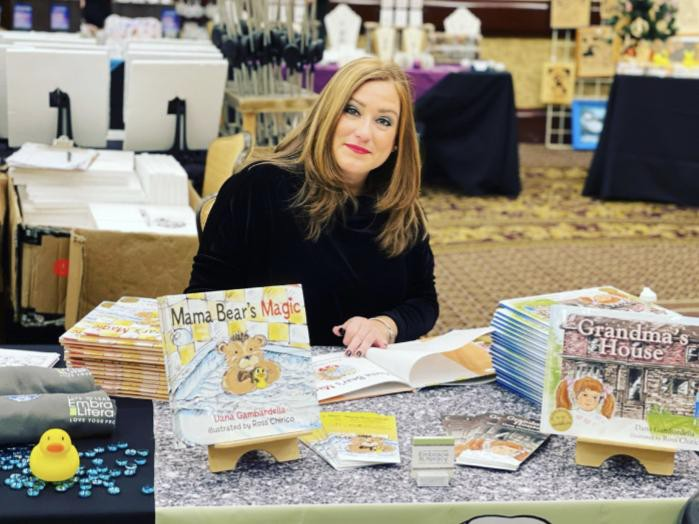
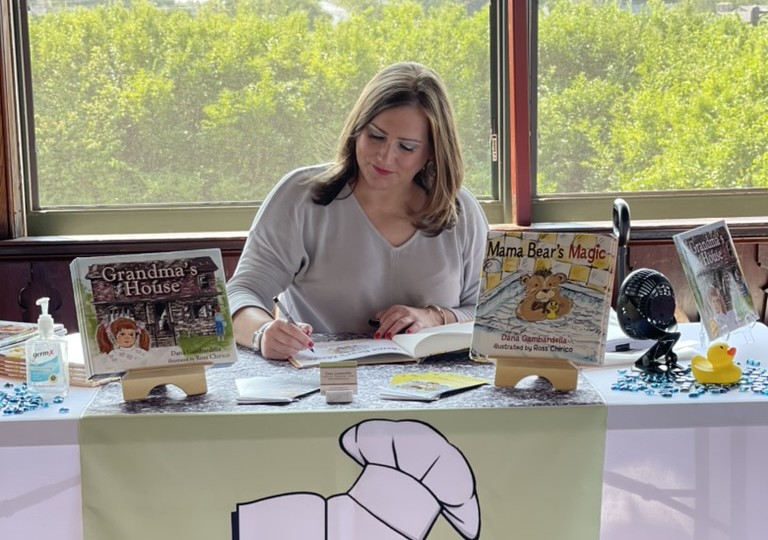
Your own books include Mama Bear’s Magic and Grandma’s House, both illustrated by Ross Chirico. Give us an overview of each please — and tell us what and who inspired them (we’re guessing your paternal grandmother!).
Mama Bear’s Magic tells the story of Tiny Bear as he realizes that bath time can actually be “beary” fun! A humorous, truth-telling look at bath time illustrates how Tiny Bear overcomes his apprehension for the bath because of Brother Bear’s modeling and Mama Bear’s clever approach. It’s like magic!
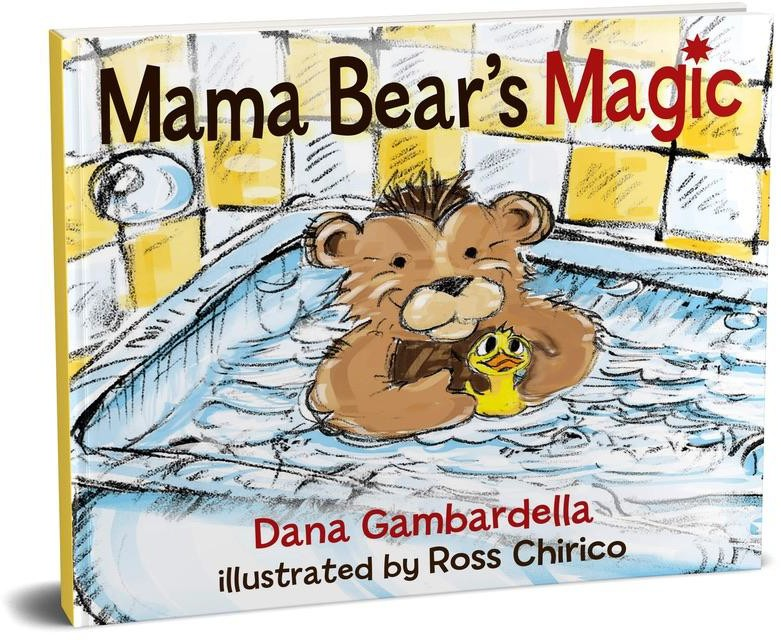
Mama Bear embraces Tiny Bear’s process as he discovers that bathing is an enjoyable, healthy practice. The bright illustrations capture the heart of the story and its readers, thanks to illustrator Ross Chirico.
I believe in honoring the contributions of every mother, which is why I dedicated this story to my own mother. I intentionally designed Mama Bear to reflect her, giving her pink rollers and a blue housecoat—just as my mother wore when she woke me each morning.
The story not only engages young readers, drawing them into Tiny Bear’s personal journey, but also resonates with parents. It celebrates the bond between mother and child, presents older siblings as positive role models, and emphasizes the importance of self-care and hygiene. These qualities make it an excellent mentor text for early childhood health education and a thoughtful gift for mothers-to-be.
Grandma’s House savors the sounds, tastes, smells and feelings that come to life only at Grandma’s House. A memoir that transcends time and cultures, the book cover and illustrations replicate my paternal grandmother’s house that still stands in Providence, RI today, as well as the items in the home – my forever favorite place.
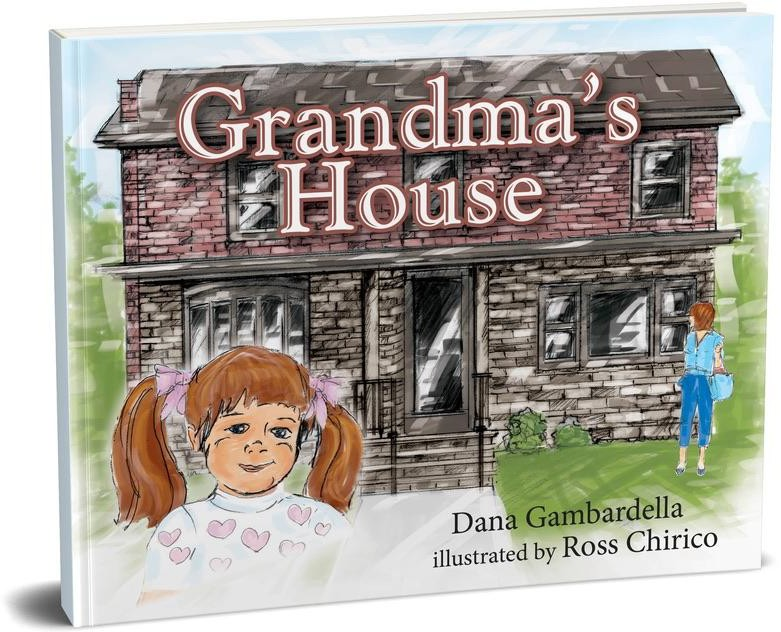
A series of vivid memories come alive through the light, impressionistic watercolor techniques on each page that lend itself to the story’s feeling of nostalgia for readers of all ages. The story then comes full circle, capturing how I process my childhood experiences in order to discover, as an adult, that our senses, thankfully, keep cherished memories alive forever.
The character’s thoughts and actions evoke emotion in readers of all ages while encouraging children to reflect on how their own experiences shape them. As a mentor text, Grandma’s House supports educators with cross-curricular connections, including the five senses, sensory imagery, memoir and descriptive writing, and social-emotional learning discussions. It also makes a thoughtful gift to honor a grandmother’s birthday or National Grandparents Day in September.
Of course my Grandma inspired this story, but it is also dedicated to my father, who, as the dedication page notes, “never fails to pick me up.” He literally carried me home from my visits with Grandma, but more than that, he has been a steady, unwavering source of strength in every part of my life. Watching how my father has embraced process and reflection in his later years reminds me that meaningful growth comes from embracing reflection and process at every stage.
You write: “I value using story as the one constant innovative practice that remains powerfully instrumental for children, adults, and learners of all ages.” We certainly agree. Can you break that down for us please?
I believe that an individual’s personal story—or process—along with the stories we encounter in print, has the power to transform our thinking. By embracing our own journeys and developing an awareness of the stories and experiences of others, we gain new perspectives and tools to grow—academically, emotionally, and beyond.
What advice would you give aspiring (or established) writers?
Practice makes permanent, so continue to hone your craft through regular writing and revision. This means intentionally carving out time to write and revise, both independently and with a trusted colleague. Though at different stages of life, doing so can be especially challenging. Time is precious, so being intentional will keep your passion and growth alive, no matter life’s demands.
What’s next for Dana Gambardella?
I am committed to modeling the practices I advocate. For example, I am dedicating more time to writing, with the goal of bringing a third children’s book to publication. Without a doubt, I will continue embracing literacy, living to learn, and loving the process!