Central to their ambition is a tumor-killing microbe
SOUTH KINGSTOWN — Dr. Kaitlin M. Dailey, a University of Rhode Island scientist and assistant professor, has an overriding ambition: she wants to cure cancer. She believes she can with a groundbreaking treatment she and her team are developing in her laboratory.
Dailey described her mission modestly but determinedly in a recent Ocean State Stories interview.
“I know how naive that sounds,” she said. “I know how complex this disease is. I also know what this disease looks like in a human when it kills that human. But I want to help. I want to cure cancer. And I think that there’s nothing right now that says that this treatment is not a viable avenue towards that.”
The treatment involves the use of a strain of bacteria injected into the bloodstream that targets and destroys specific tumors but is otherwise harmless to the body. Dailey already has found success in mice with pancreatic cancer.
“We can get to a tumor and start to change the immune microenvironment,” she said. “Traditionally, one of the reasons pancreatic tumors are very difficult to treat is that there’s not a lot of immune activity. They’re considered ‘cold.’ ”
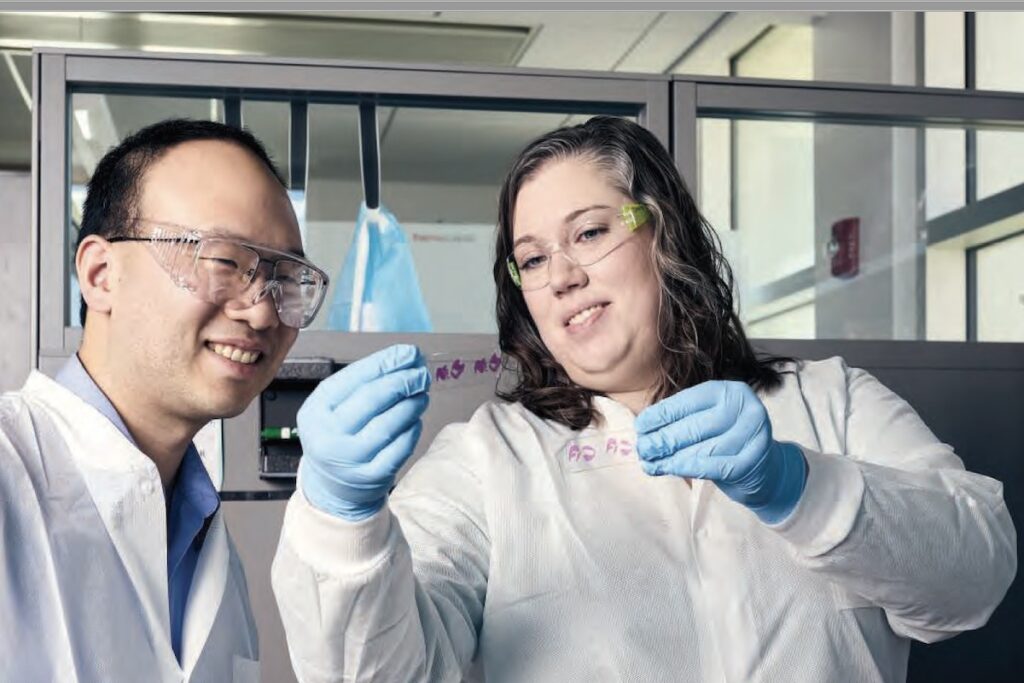
Dailey’s life journey and hardships encountered along the way, the scientist told Ocean State Stories, have led her to this encouraging research.
“I am literally a farm kid, from McPherson County, Kansas,” she said. “Our family farm has been around for more than 100 years.” McPherson County, about 60 miles north of Wichita, had a population of 30,223, according to the 2020 census; of those, 8.3% lived in poverty. This percentage was higher when she graduated from high school in 2009, Dailey said. As a child, she was one of those county residents.
“I grew up below the poverty line, with all of the designations of underserved and minoritized and disadvantaged,” she stated. “I’m very open about those things because I want people to know that you can do it. You should bet on yourself and you can figure it out. And you can cross the poverty line. But it’s not easy. This is not a system that is built for somebody like me.”
Dailey said she “fell in love with science during my sophomore high school biology class,” taught by a “really fantastic teacher, Mr. Andrew Albright. I blew through the entire year’s worth of curriculum very quickly and he didn’t know what to do with me. So he would just send me to the library with his college genetics textbook and have me read it.
“So I knew very early on that I wanted to be in science, though I didn’t always know what that exactly looked like. I changed my major a couple of times in college, but I had really great mentors and friends and teachers along the way who helped me get there.”
Dailey received her bachelor’s degree in biology from North Park University in Chicago; and her Ph.D. in Cell and Molecular Biology, Genetic Engineering, Pharmaceutical Sciences, from North Dakota State University, in Fargo. In August 2025, she arrived at URI’s College of Pharmacy. She is also affiliated with Brown University’s Legorreta Cancer Center.
In May, URI announced her research in a press release that noted clinical trials of the treatment were conducted at Johns Hopkins University. Dailey and her team, the release stated, are “expanding on that work to more specifically target tumors that are difficult or impossible to access, especially those associated with pancreatic cancer, one of the deadliest types.
“Dailey’s lab is working with the microorganism Clostridium novyi-NonToxic, reengineering the already non-toxic bacteria through a first-of-its-kind synthetic and engineering biology platform for targeted gene editing. Those edits allow the bacteria to be injected into the bloodstream without causing sepsis, giving it a chance to access hard-to-reach tumors, and even metastatic cancer, regardless of where the tumor is in the body.”
Dailey’s URI website page states that the bacteria “has the potential for efficacy against a broad spectrum of solid tumors – as well as health applications during long-duration space travel. Such space health applications include generating energy as microbial fuel cells and on-demand pharmaceutical secretion to replace required medicinal payloads.” Dailey recently received a funding award from NASA to help with her research.
Results of the Johns Hopkins trial, which was conducted on dogs, were published in 2014. “Objective responses were observed in 6 of 16 dogs (37.5%), with three complete and three partial responses,” the university concluded. “This treatment reduced the tumor within and surrounding the bone. Together, these results show that C. novyi-NT can precisely eradicate neoplastic tissues and suggest that further clinical trials of this agent in selected [human] patients are warranted.”
One such trial is underway at UT M.D. Anderson Cancer Center at the University of Texas in Houston, which described its work as a “first-in-human study.” Center scientists wrote on clinicaltrials.gov that “Single intratumoral injection of C. novyi-NT in combination with pembrolizumab has been demonstrating manageable toxicity profile and encouraging signals of anticancer activity.”
The UT M.D. Anderson Cancer Center caught the attention of Kansas City, Missouri-based pharmaceutical firm BVD, which describes itself as “a clinical-stage biotechnology company on a quest to make a meaningful difference for patients.” Wrote Brent Kreider, president of BVD, “With promising therapeutic viability data now in hand for CNV-NT as both a monotherapy and a combination therapy, we are evaluating possible partnerships for the next stage of development.”
Speaking with Ocean State Stories, Dailey said that further inspiration for her research is found during the time she spent at the University of Nebraska’s Fred & Pamela Buffett Cancer Center, named for the late Fred Buffett, a first cousin of philanthropist and investor Warren Buffett, who was born in Nebraska.Dailey was also co-affiliated with the Eppley Institute for Research in Cancer and Allied Diseases.
“One wing of the building was the patient wing and one wing was the research wing,” Dailey stated. “What that meant was I shared Starbucks, bathrooms, and elevators. I knew patients’ faces, I knew what it meant when they started coming in with their families. And I knew what it meant when they stopped coming in.”
Daily said her research “is a hard thing to do. There’s a reason not very many people do it. But I do it because I know what cancer looks like. Cancer’s touched all of us, very close family members and friends. I get emails and texts all the time about it. We can do better. And we can do it in a way that doesn’t exclude you based on your socioeconomic or insurance status.”