By MIMI REITZ, Beacon Media Contributing Writer Jul 22, 2026
This story was originally published in the Warwick Beacon, a publication partner of Ocean State Stories.
Read this story in its original form and all other Beacon stories by clicking here.
PROVIDENCE — In a state known for its sparkling waters, Rhode Island’s lakes, ponds and rivers have been through a difficult few decades, as modern pollution and chemical-laden stormwater taints local waterways and limits Rhode Islanders’ ability to enjoy the waters and wetlands of the Ocean State.
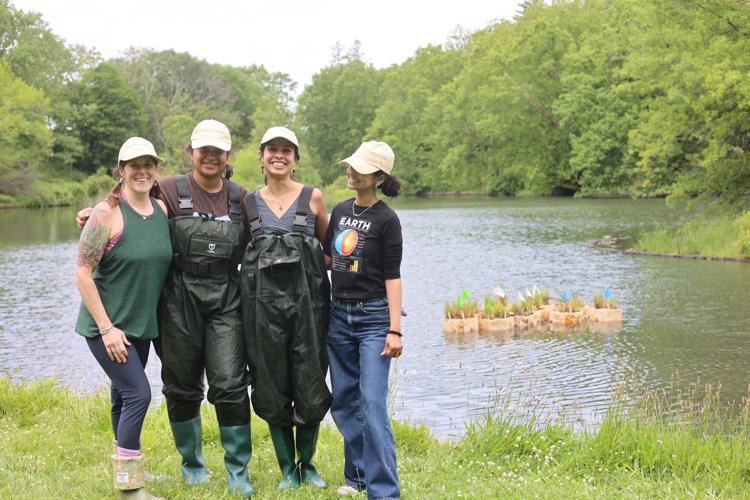
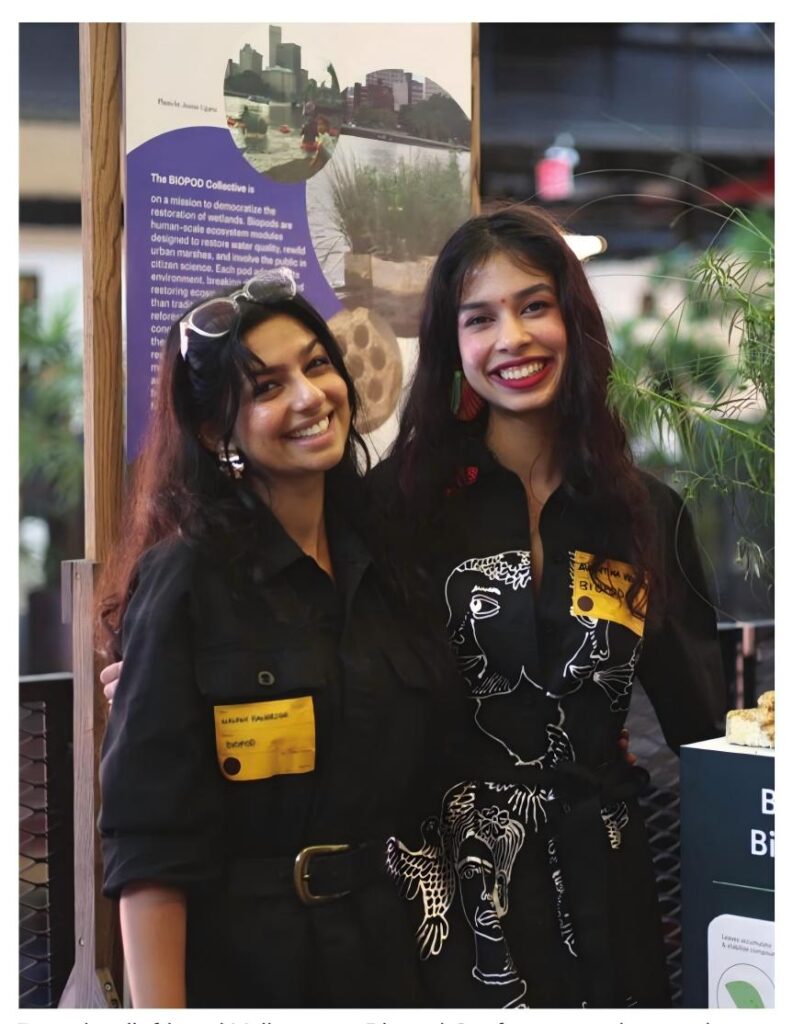
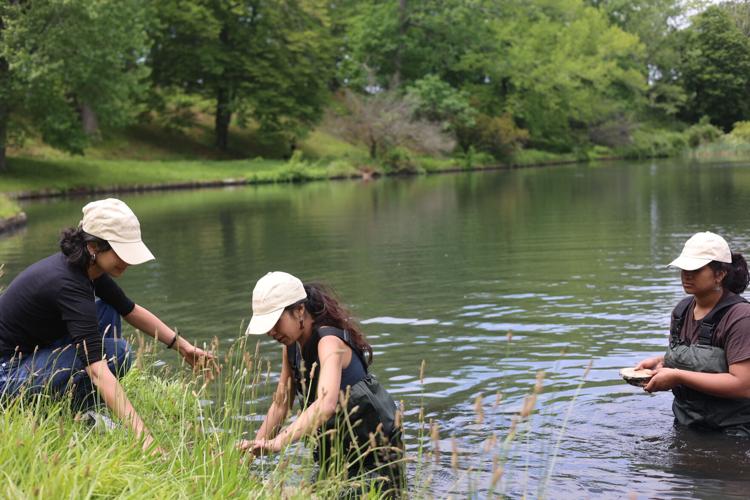
But in June, two bright-eyed young graduates of the Rhode Island School of Design (RISD) deployed a lush, living sponge in Roger Williams Park’s Roosevelt Lake to counter these industrial challenges — part of the “Biopod Co.” pilot project sent to cleanse and heal a beloved piece of urban nature.
Avantika Velho and Manini Banerjee have turned a student project with a “warm fuzzy vision” of nature-first, community-led environmental restoration into an organization involving hundreds of passionate volunteers and partnerships around the globe.
“Usually restoration is very slow and expensive. It’s top down. Governments have to sanction whole swaths of land to be re-wilded, and communities that are affected by it have no way of really engaging with this beyond volunteering,” said Banerjee. “Our main goal was to lower the barrier of entry to this type of work.”
Their “biopods” were born in a RISD lab while the two studied industrial design in Providence — the result of collaboration and innovation that combined biology with technology and birthed this unique living infrastructure. The students’ mutual passion for social impact and environmental restoration bonded them — calling each other their “twin flames.”
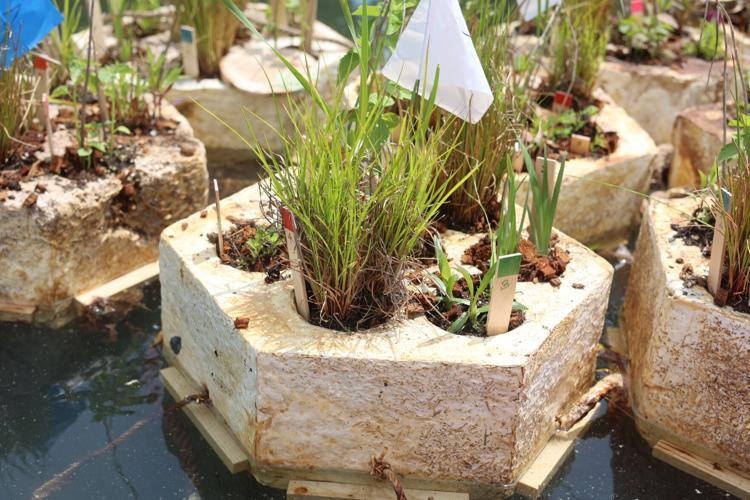
Each 18-inch-square biopod has two layers. Native wetland plants grow on top, while below the surface a floating mat of mycelium — the root-like structure of fungi — is woven together with agricultural waste. Together they create a miniature wetland that breaks down pollutants, traps heavy metals and provides habitat for beneficial bacteria and algae through a process known as bioremediation.
In 2022, their team won seed funding through a RISD grant called the “Somerset Sustainability Innovation Fund,” and in 2024 they continued their success as a winner of the international “Terra Carta Design Lab.” The grants allowed Biopod Co. to grow in every sense. By the end of this summer, they will have created four “micronodes” where communities have deployed biopods in local bodies of water: the Bushwick neighborhood of Brooklyn, New York, the cities of Providence and Barrington in Rhode Island, and Goa, India — where Velho grew up, on the West coast of India.
The team always sought to work directly with nature. “We wanted to meet nature where it’s at,” Velho said. “With communities front and center.” By hyperlocalizing the deployment of the pods, their team was able to build knowledge and skill-based capacity so that locals could sustain and propagate the pods themselves long-term.
And for Velho and Banerjee, a key part of that process has been building relationships with local experts and organizations who are already embedded in the ecosystems they are trying to help. Their diverse partnerships include the Stormwater Innovation Center, the Audubon Society of Rhode Island, the Providence Parks Department, Bloom Rhode Island, and the Roger Williams Natural History Museum, among others — each of which contribute in different ways to the genuine enthusiasm for this project alongside eager local volunteers.
Sara Horvet, the outreach and engagement program manager at the Stormwater Innovation Fund, who has been assisting in the biopod pilot at Roosevelt Lake and in Barrington, said that signups for community workshops to build and deploy biopods filled up the fastest that she’s ever seen.
“We had a whole auditorium filled with people that were ready to get their hands all dirty,” she said.
Their workshops, which demonstrate to residents how they can create and grow their own biopods, are a part of the mission itself — instilling a sense of agency in a world experiencing climate change and building community as new “citizen scientists” form a corps dedicated to caring for their environment.
“We try to make our workshops as easy as possible to understand — so that people feel confident in their ability to grow their own material,” said Velho. “It’s not just building with wood or metal or paper like you’re used to — people can be trusted to build with living materials.”
Maud Highfield, a Providence resident, volunteers with Biopod Co.’s project at Roosevelt Lake. She is happy to participate in something she says “is paving the way for innovative solutions to help fix the climate crisis” — and more than that, it’s become something that ties the community together.
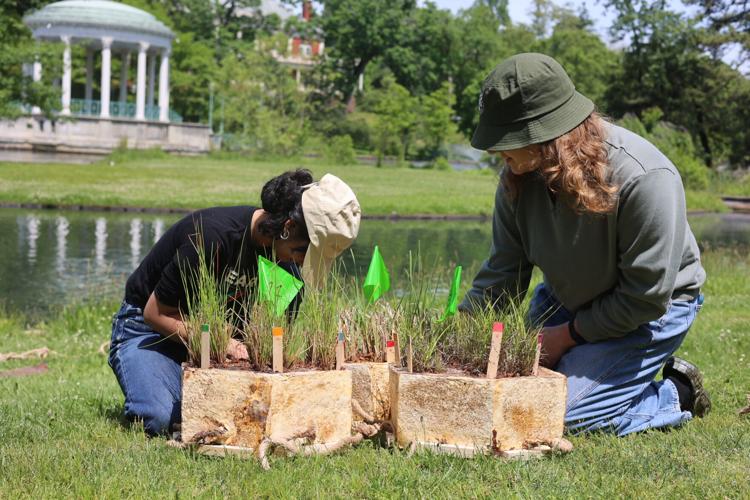
“Avantika and Manini really foster this environment where everyone is an integral part of this big thing,” Highfield said.
For Velho and Banerjee, who grew up in coastal regions of their own (in India and Singapore, respectively), Rhode Island waters and the community that takes care of them have a special place in their project — and hearts.
“Rhode Island has been this crazy place of amazing people that are so passionate about their water,” said Velho. “Honestly, I get emotional talking about it, because it’s been so amazing to see how people want to actually help.”
While the two now live in Boston, studying in the Masters of Design Engineering program at Harvard University, Banerjee says “It doesn’t feel like we’re not there because there’s so many people who genuinely care and believe in the technology so much that they’re putting their own time, their own effort, everything into it, even when we’re not there.”
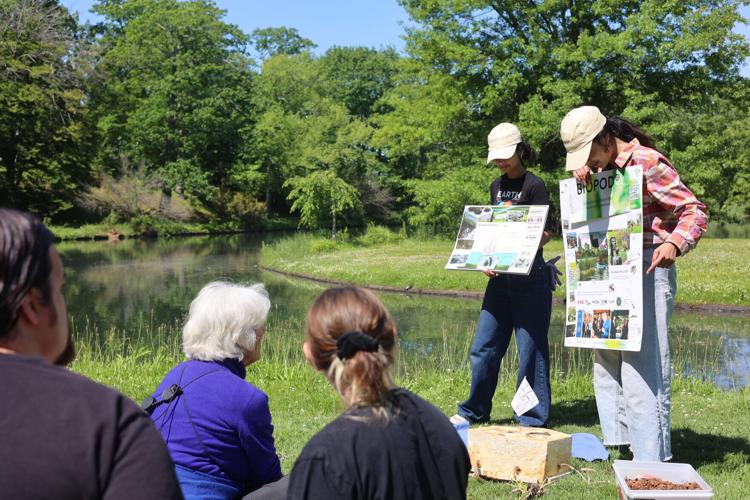
The biopods in Roosevelt Lake have permits to remain there for the next 12 to 16 months, after which time the team will remove them, dissect the materials and investigate how they worked. Every week, volunteers send photos and updates to the team as the pods continue to grow and hopefully, remove harmful materials from the lake.
For Horvet, the best part about this inspiring pilot initiative was watching Velho and Banerjee as they sent their first biopod into the water in Roger Williams Park.
“Seeing those pods actually enter the water, and to look at their faces, and to see their genuine joy made me cry,” she said. As volunteers clapped, hooted and hollered at the send-off, Horvet said you could tell that this was more than a pet project or a “greenwashed” corporate initiative. “This is their pride and joy.”