CRANSTON — As well-intentioned as it may be, the traditional response to a behavioral health crisis — cruisers outside, uniformed police officers at the door — can escalate the situation, sometimes with unfortunate consequences.
A pioneering program has changed that in Cranston.
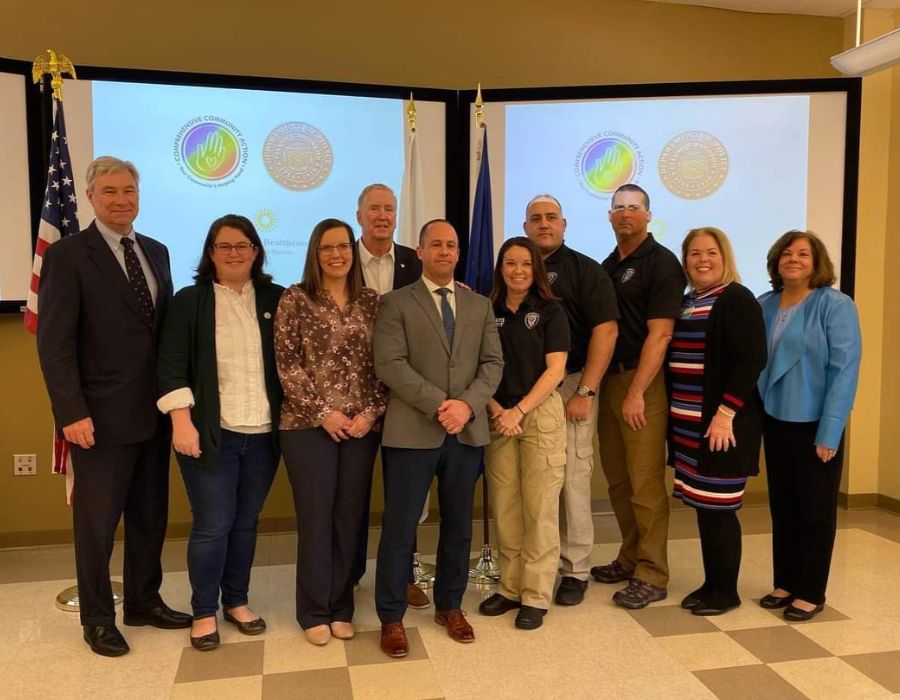
The Crisis Intervention Team, CIT, is a partnership of Brown University Health’s Gateway Healthcare, the Comprehensive Community Action Program (CCAP), and the Cranston Police Department. It provides “a unique response to those experiencing a mental health crisis,” according to the department’s website.
“Our officers on this specialized team receive extensive training on de-escalation techniques as well as how to recognize signs of a potential mental illness.” Gateway “provides an on-scene psychiatric crisis assessment.”
In a recent interview, two of the principals with the program, which has won CIT International certification, discussed its techniques, origins, and successes so far.
“Typically, if we did not have the program, a call would come in through 911,” said Amy McCarthy, a licensed clinical social worker with Gateway Healthcare. “Police respond — sometimes with lights and sirens, sometimes they just pull up. Depending on the situation, they could forcefully put somebody in an ambulance. It’s never a good day when police are knocking on your door.”
With the Crisis Intervention team, however, McCarthy said, “when that same call comes in to 911 we have a plainclothes officer in an unmarked car responding with a clinician. The clinician does the same exact psychiatric assessment that is done at all the Brown University Health hospitals, in real time: ‘What is going on with that patient? Do they need to go to the hospital? Can they stay home? Do they need to go to the hospital against their will?’ They have the ability to figure all of that out on scene.
“If we have to call for a rescue, we try to do it as low-key as possible. Again, no lights, no sirens, because we don’t need all the neighbors to come outside and look and see what’s going on. We want that client to feel like they’re getting treatment and not getting arrested per se by getting thrown in the back of a cop car.”
Cranston Police Captain Justin Dutra is commander of the department’s Community Outreach/Special Projects Division. During the Ocean State Stories interview, he described the various ways a behavioral crisis can come to the attention of law enforcement.
“A police officer can get a call of an erratic vehicle operator and they stop that erratic operator,” he said. An immediate determination must be made: “ ‘Are they just an aggressive bad driver? Are they intoxicated? Are they having some sort of mental health crisis?’ So a traffic stop can be a mental health crisis call for service.”
Similarly, Dutra said, a domestic dispute can trigger a police response. Before the Crisis Intervention Team, “there may have been an arrest involved. There may be a domestic assault, but what started the fight? With a mom or dad, husband or wife, was there a substance-abuse issue? Were there mental health issues going on?”
Dutra brings a wealth of training and education to the CIT. In 2001, he graduated from the University of Rhode Island, earning a bachelor’s degree in sociology with a minor in psychology. “His division is responsible for various police department outreach initiatives, crime prevention programs, crisis intervention response, police explorers, constituent affairs liaison with city hall, and all other projects and initiatives tasked by the Chief of Police,” according to the department website..
McCarthy also earned a Bachelor of Arts degree in 2003 from Rhode Island College, followed by a Master of Social Work degree from the college in 2016. In 2024, she was honored for her work in Cranston by Crisis Intervention Teams of RI, an organization that supports similar programs in other cities and towns in Rhode Island.
“She started with an idea that the department expressed during the CIT academy in January of 2021 and facilitated resources and buy-in from essential partners,” the organization stated in her nomination. “Once funding was secured by the department, the outreach efforts by her team and CCAP, has been unapparelled. Not only has it helped the community of Cranston, but it has aided our officers with the stigma surrounding mental health and illness. She has broken down barriers to have those conversations whether it’s her clinicians on the road with officers or at Headquarters.”
In the last two years, the approximately 20 officers with the Cranston CIT made about 2,000 calls. Many of these crises were managed without hospitalization being required.
“The CIT International certification is a significant achievement for Cranston and reflects the strength of that partnership,” McCarthy said. “At the same time, our work extends well beyond Cranston. We collaborate with law enforcement agencies in Pawtucket, North Providence, North Kingstown, and Westerly, helping communities across Rhode Island build effective responses to behavioral health crises.”