
The scientific consensus is that wind power significantly reduces fossil fuel use and has a much lower carbon footprint than any fossil fuel-based electricity generation.
This story was originally published in EcoRI News, a publication partner of Ocean State Stories.
PROVIDENCE — To buttress their opposition to offshore wind development, opponents have claimed these sea-bound turbines rely, significantly, on diesel generators to operate.
Few outside the opposition, however, substantiate the allegation of long-term diesel generator use in the offshore wind industry.
Renewable energy projects, including offshore wind, do use diesel generators, mostly during construction. They are also used by offshore wind developers to power up turbines during testing, which usually means moving several around a project site. They are typically removed once a project is operational. In some areas, diesel generators are used to jump-start turbines, both land- and ocean-based, after being idle for some time or to warm them in really cold weather.
Offshore wind projects typically use generators for auxiliary power during installation, maintenance, and commissioning, or as a short-term, emergency backup to prevent freezing in low-wind conditions when grid connection is down. These diesel generators are often on support vessels or in substations, rather than in every individual turbine.
The Revolution Wind environmental impact statement only mentions diesel generators a few times, for use in emergencies. “Such activity would result in short-term, intermittent, and widely dispersed emissions and small air quality impacts,” according to the 2,874-page document.
Last year Ørsted, the developer of several Northeast offshore wind projects, including Revolution Wind, signed a multiyear agreement with OEG Renewables to provide temporary power during the commissioning of projects. The agreement stipulated that OEG Renewables provide eight portable generators with technician support.
“Within the offshore wind industry, it is standard practice to temporarily use small diesel generators during a wind farm’s commissioning phase to help supply power for the optimizing and testing of the turbines,” a Revolution Wind spokesperson recently wrote in an email to ecoRI News. “Those generators are removed from the turbines once commissioning is complete and the wind turbine comes online.”
Each of the 65 Revolution Wind turbines includes a tower; a nacelle, a cover housing the generator, gear box, drive train, and brake assembly; and a rotor that includes three blades.
The issue of diesel generators and wind turbines came to a head locally this summer, when Rhode Island resident Michael Lombardi, a professional scuba diver and a member of the anti-wind group Green Oceans, wrote an opinion piece for ecoRI News.
In it, Lombardi noted he took a boat to the Revolution Wind site and “I was unprepared for and then appalled to see that each turbine has a large diesel generator positioned outside on a platform over the water, and most were running.”
He claimed that when the wind doesn’t blow sufficiently to generate power, which he alleged is 60% to 70% of the time, the generator “kicks on to keep things moving such that bearings do not wear or seize.”
His wind assessment doesn’t jive with federal government findings, or how turbines operate, according to the industry.
“The U.S. offshore wind resource is abundant and the wind pattern closely resembles electricity demand, peaking in the afternoon and evening hours,” according to the Bureau of Ocean Energy Management. “Offshore wind power results in few or no environmental impacts in specific areas such as emissions of carbon dioxide, mercury, nitrous oxides, and sulfur oxides compared to conventional electrical power generation.”
Recently operational South Fork Wind, a 12-turbine, 132-megawatt offshore wind facility 35 miles east of Montauk Point, N.Y., proved to be a “reliable source” of renewable energy during its first year of operation, according to the Long Island Power Authority.
“While wind patterns are seasonal and vary by geographical location, offshore wind energy production in New York is highest during the winter months, when winds are strongest and most consistent,” according to the LIPA. “However, offshore wind turbines generate power almost all the time.”
Lombardi also claimed that “thousands of gallons” of diesel are stored, along with a “multitude of petrochemical lubricants,” at each turbine.
When asked in follow-up emails how much fuel a Revolution Wind temporary, small diesel generator holds, the Ørsted-hired spokesperson responded: “Hi Frank — I don’t have that info. Have a nice Thanksgiving!”
Drew Carey, the co-founder of Newport-based INSPIRE Environmental, which has worked with Ørsted since the Block Island Wind Farm, recently told ecoRI News that “these temporary generators are there to support the commissioning process.”
“It’s a pretty complex process of configuring everything and you expect it to work, right?” the marine scientist said. “It’s not as simple as let the turbine start turning and it generates electricity and floats into the grid. During the process of finalizing everything you need some power. It’s a little bit like a temporary workspace, where they bring in a generator in order to help them complete everything. Then once the turbine is commissioned, it’s self-sufficient.”
Carey said Lombardi jumped the gun on his assumptions about the use of diesel generators.
“I had seen this where he posted a picture of a generator and said, ‘Oh my God,’ and then just went off on a pretty substantial projection as to what it must mean,” Carey said. “The most important takeaway is that [diesel generators] are one of many pieces in the process of achieving a system that requires maintenance, but is designed to generate relatively clean energy during periods of wind.”
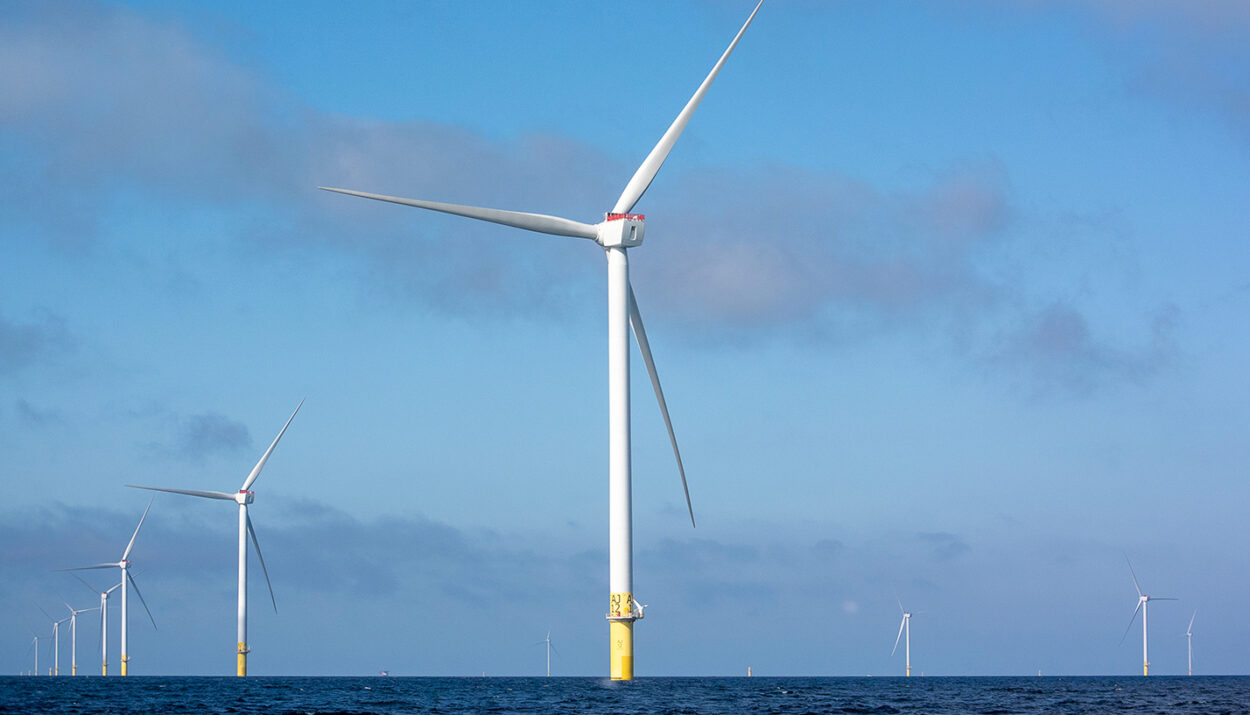
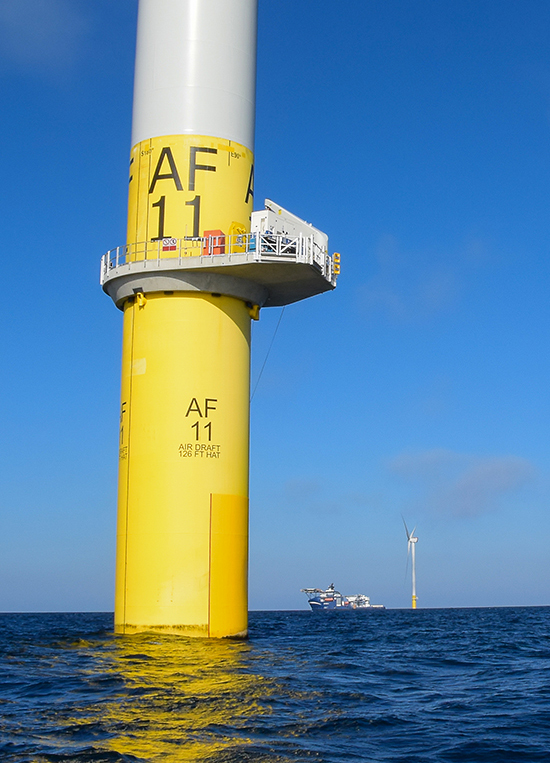
Carey noted the photos he provided to ecoRI News (above) from a recent visit to the Revolution Wind site show a temporary diesel generator on a small platform (second photo) and a row of turbines in the distance without the fossil fuel apparatus (lead photo).
The five-turbine Block Island Wind Farm, the country’s first offshore wind facility, replaced the island’s extensive use of diesel power. Prior to the turbines, New Shoreham relied solely on about a million gallons of diesel fuel annually for its electricity. It was delivered by boat and burned on the island, which produced some 40,000 tons of carbon dioxide emissions every year.
Science Feedback has noted “attacking renewable energy for supposedly being ‘unreliable’ or ‘dependent on fossil fuels’ is a common tactic of renewable energy opponents.”
The nonprofit, which verifies the credibility of influential information and media coverage that claims to be scientific in fields that are particularly prone to misinformation such climate change and public health, says diesel generators are occasionally used for wind turbine maintenance and that some remote areas rely on a combination of diesel and wind for their power.
“This does not mean diesel actually powers wind turbines,” according to Science Feedback. “[T]here would be little point in doing so; it would be far more efficient to plug a diesel generator into the grid directly and skip the wind turbine entirely.”
Roger Warburton, associate professor emeritus of administrative sciences at Boston University, recently told ecoRI News a paper published in October 2011 by Cornelis Le Pair is responsible for much of the misinformation swirling around wind turbines.
The Newport resident said the 14-year-old paper started a conspiracy theory and “these conspiracy theories never die.”
Le Pair’s paper, often cited by anti-wind opponents, claimed wind turbines increase fossil fuel consumption and emissions. His hypothesis, published on his personal website, wasn’t peer-reviewed and didn’t reflect the full picture of grid management and carbon accounting.
Le Pair’s claim has since been refuted by peer-reviewed life-cycle analyses. The scientific consensus is that wind power significantly reduces fossil fuel use and has a much lower carbon footprint than any fossil fuel-based electricity generation.
A 2024 paper titled “Rebutting 33 False Claims About Solar, Wind, and Electric Vehicles” published by the Sabin Center for Climate Change Law at Columbia Law School noted that on a life-cycle basis, wind power emits far less carbon dioxide than fossil fuels per kilowatt-hour of energy generated.
According to the National Renewable Energy Laboratory and the Intergovernmental Panel on Climate Change, the average emissions of offshore and onshore wind turbines average 11-13 grams of carbon dioxide equivalent per kilowatt-hour over their entire life cycle, from manufacturing to decommissioning. Life-cycle emissions for fossil fuels are far higher, with natural gas and coal releasing 437-758 grams and 675-1,689 grams, respectively, of CO₂ equivalent per kilowatt-hour.
“Fortunately, it seems that people are no longer using his name, but the idea that wind farms generate more CO₂ than they save still lingers,” Warburton said. “Total nonsense. On average, nine months after startup, they have saved more CO₂ than used in their production.”

Offshore fossil fuel platforms rely on power from diesel generators for many things, from lighting to drilling. (istock)
While offshore wind turbines have diesel generators, largely for specific, temporary needs, they don’t use them as a primary power source like fossil fuel platforms, say, in the Gulf of Mexico.
Diesel generators are regularly used on offshore oil and methane rigs to meet the needs — electricity and hot water, for example — of those working and living on the platforms.
The fossil fuel industry also routinely runs diesel generators at remote locations on land. The industry relies heavily on diesel generators for remote operations and as a critical backup power source. It also uses generators to power heavy machinery for drilling and pumping in areas without grid access, such as offshore platforms.
“Oil rigs operate in some of the most challenging and remote environments, where reliable power is essential for continuous operation,” according to Americas Generators.
Offshore platforms also require specialized petrochemical lubricants for machinery, such as engines, gears, pumps, and drills, that need high thermal stability, water resistance, and wear protection in harsh marine environments.
Carey noted that some fossil fuel platforms are like floating hotels. Modern rigs often have cinemas, game rooms, gyms, and Wi-Fi. Unlike wind turbines that eventually produce their own power, offshore rigs aren’t burning the oil or gas they are extracting from the ocean floor. The crew, which can range from 50-200 people, needs power to work, eat, and play.
He said in Europe, particularly in Norway, they are putting wind turbines next to oil and gas platforms to replace diesel power.
Carey also spoke about a growing practice called repowering.
“They take the oil and gas platform away and put a wind turbine in its place,” he said. “So they’re making use of the all the clearance and the structure. They’re just saying, ‘Hey, we got this big piece of steel out here that’s got stuff growing all over it. Let’s put a turbine where we’ve exhausted the reservoir. It’s not worth pumping anymore.’”
In Scotland, the country’s first land-based wind facility was repowered with newer turbines, and no new disturbance of the landscape.
The United States’ growing collection of energy-sucking data centers also commonly use diesel generators for backup power, as do hospitals and many homes and businesses. Most fishing boats are powered by diesel. Diesel power is also crucial for mining industry operations.
Diesel generators can have a significant impact on public and environmental health. Diesel engines produce more pollutants, such as carbon monoxide, nitrogen oxides, and particulate matter, than gasoline engines.
To give readers an idea of the view field of the Revolution Wind project, I took two photos from the water’s edge during low tide at Easton’s Beach (First Beach) in Newport on Nov. 18, a mostly sunny day with few clouds. One photo was taken with a traditional lens and the other with a zoom.
Note: To watch a 10-minute video about the installation of offshore wind turbines, click here. Drew Carey is a former ecoRI News board member.