
Originally published by The Providence Eye, a publication partner of Ocean State Stories.
PROVIDENCE — At the start of 2018, the Providence Fire Department launched Safe Stations, a program designed to provide 24/7, free walk-in access to services for people struggling with substance abuse.
Providence Fire Department’s Chief of Emergency Medical Services, Zachariah Kenyon, proposed the program in late 2017 and by January 2018, they were up and running at every Providence fire department. At the time, many of the existing state-funded initiatives focused on intervening after an individual was revived from an overdose, Kenyon told The Providence Eye. He thought there was another way to help those aiming to start the road to recovery, providing access to care before the worst-case scenario happened. Inspired by successful models in Manchester and Nashua, New Hampshire, he wanted to“give people a place that they could go to at any point in time, 24/7, where they knew they could get help — not necessarily right after the overdose, but when they were ready.”
Prompted by the state of Rhode Island’s Overdose Prevention Action Plan, the goal is to reduce overdose-related deaths in both the city of Providence and across Rhode Island.
Accessing a Providence Safe Station
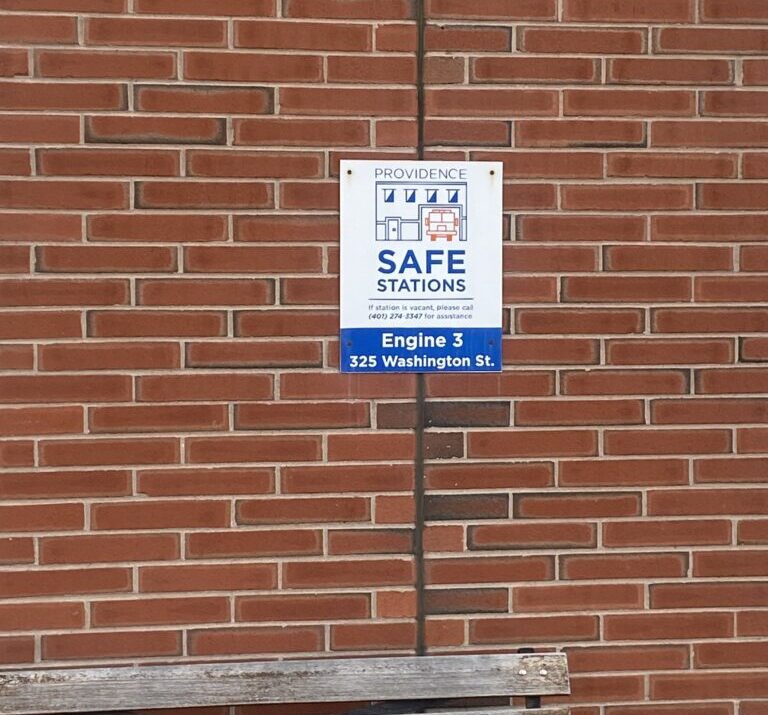
Safe Stations are available at all 12 Providence Fire Stations. Anyone, regardless of whether they are a Providence resident or not, can show up at any time, any day, can enter any Providence fire station, ring the doorbell, and request help without the fear of legal consequences.
Immediate support is handled by EMT-certified firefighters who conduct a basic medical screening including blood pressure, blood sugar, and trauma checks. If screenings show immediate medical attention is needed, the individual will be transported to a hospital. Otherwise, the staff calls a hotline which connects them to community-partner peer recovery coaches, who aim to arrive at the safe station within fifteen minutes.
It is important to note that the fire department does not determine long-term treatment placement, nor do they keep track of those who access the Safe Stations after they have been connected with services. The goal and jurisdiction of Safe Stations is to provide immediate help and connect those in need to recovery resources. They also provide a space in which the individual can safely dispose of substances (drugs), if necessary.
The ultimate goal is to “Treat the person as nicely as possible, give them a lot of respect, make them feel like they know they’re in a place where they’re going to get help,” as well as making sure they are in a safe state to go with the recovery coach, says Kenyon.
Community transfer partners include BH Link, a 24/7 behavioral substance use triage center in East Providence, Butler Hospital, The Providence Center, and direct placement in a treatment center if there are beds and space available.
A key aspect of what makes Safe Stations effective is the no-consequences policy. For individuals struggling with substance abuse, prior interactions with law enforcement may create fear and hesitation, with the fear of consequences overcoming the desire to receive help. With the Safe Stations’ policy, and the removal of law enforcement from the intake process—as well as giving individuals a space to safely dispose of substances without immediate repercussions—the program lowers one of the most significant barriers to treatment. The message is simple, but holds a lot of power, sending a message that these stations are for help and not punishment.
Who Has Been Helped?
Since its start, Safe Stations estimates that it has aided over 500 people looking for help. When asked if there were any trends in who was able to access care through the Safe Station, Kenyon told The Providence Eye that, although people from all different parts of the state and beyond, of all backgrounds, have accessed support through Safe Stations, he notes that the three busiest stations include the Public Safety Complex, the Branch Avenue Station, and the North Main Street Station.
In terms of trends learned throughout the process, the majority of people are poly-substance users, which is defined as an individual who consumes two or more substances intentionally or not, as per the CDC. While program leaders initially thought the main demographic targeted would be roughly 20 to 25 year old white males, Safe Stations have been accessed by more people outside of that demographic, with an increase in folks seeking help who are Hispanic and African-American.
He also shared that while the program started for opioid abuse, that is not all it is there for. Individuals who suffer from other substance abuses could go to a safe station to receive help as well—including alcohol and non-opiate drugs. “We’re here to help people no matter what they’re using, and that’s really the key people need to know.”
Program Evolution and Long-term Outcomes
In terms of long-term outcomes, the program does not receive information from peer counselors as to where a patient may have ended up or not, due to HIPAA laws, and so these outcomes are not explicitly tracked. However, Kenyon did share that anecdotally, there have been positive outcomes, with past visitors returning to share that the program helped them enter recovery.
While Providence Safe Stations have not seen the volume initially expected, its impact cannot be measured by numbers alone. The initial expectations for Safe Station use in Providence was shaped by program implementation in New Hampshire, where higher visit counts were recorded. In Providence, Safe Stations have had fewer repeat visits, which could be optimistically interpreted as individuals being successfully connected to lasting recovery resources. However, without more robust followup with those who access services, it is impossible to know if low rates of use indicate positive outcomes for those who seek help through Safe Stations.
One of the program’s greatest ongoing challenges is visibility. Despite numerous television appearances, newspaper coverage, billboards, and community outreach, many Rhode Islanders seem to be unaware that they can walk into a Providence fire station any time and ask for help.
The lack of widespread awareness is a concern, especially in light of the continued number of overdose deaths in Rhode Island. When speaking to The Providence Eye, Kenyon expressed that success for the program would ultimately mean driving the number of deaths to zero, saying “It’s just still too many people dying from overdose in the state of Rhode Island, and so we need to change that. If that goes to zero, then that will be a success.”
Still, every life saved represents more than one person helped, as it represents the families and communities impacted by an individual receiving help when they are ready to ask for it. Like a ripple effect, when one person is saved it can impact hundreds of others.
Kenyon noted the program’s greatest success in saying, “We’ve helped people change their lives, right? And so we’ve given them another chance at life to be with the people they love and to be with their families again and be productive and be happy. […]There’s so many people involved with that person that you don’t even think about. And so that’s the greatest success. One person that’s changed makes the program worth it.”
The Providence Safe Stations Program has inspired other communities to follow suit. Across Rhode Island and Massachusetts—East Providence, West Warwick, Woonsocket, Smithfield, Pawtucket, Newport, Fall River, Bristol, and Tiverton—fire and police departments have adapted the model in ways which work for their communities. Beyond the northeast, cities such as Minneapolis and Cincinnati have looked to the program for inspiration.
This is something that has been encouraged by program leadership, with Kenyon saying “It’s nice that all these other communities have stepped up and done something. … I freely share all the information and try to promote that they do something to make their community safer.” The only consistent request has been that all participating Safe Stations keep the recognizable logo so that wherever someone sees it, they know they can walk through the door and find help.
“That’s the biggest goal, to make sure people know that people do have an option. If they decide at any time, day or night they want change, we’re here,” said Kenyon.
Daneisha Rodriguez is a former Brown University SPRINT Fellow at The Providence Eye. She studies English, specializing in Nonfiction Writing and Data Science Fluency. She is the co-editor in Chief of SOMOS Latinx Literary Magazine.