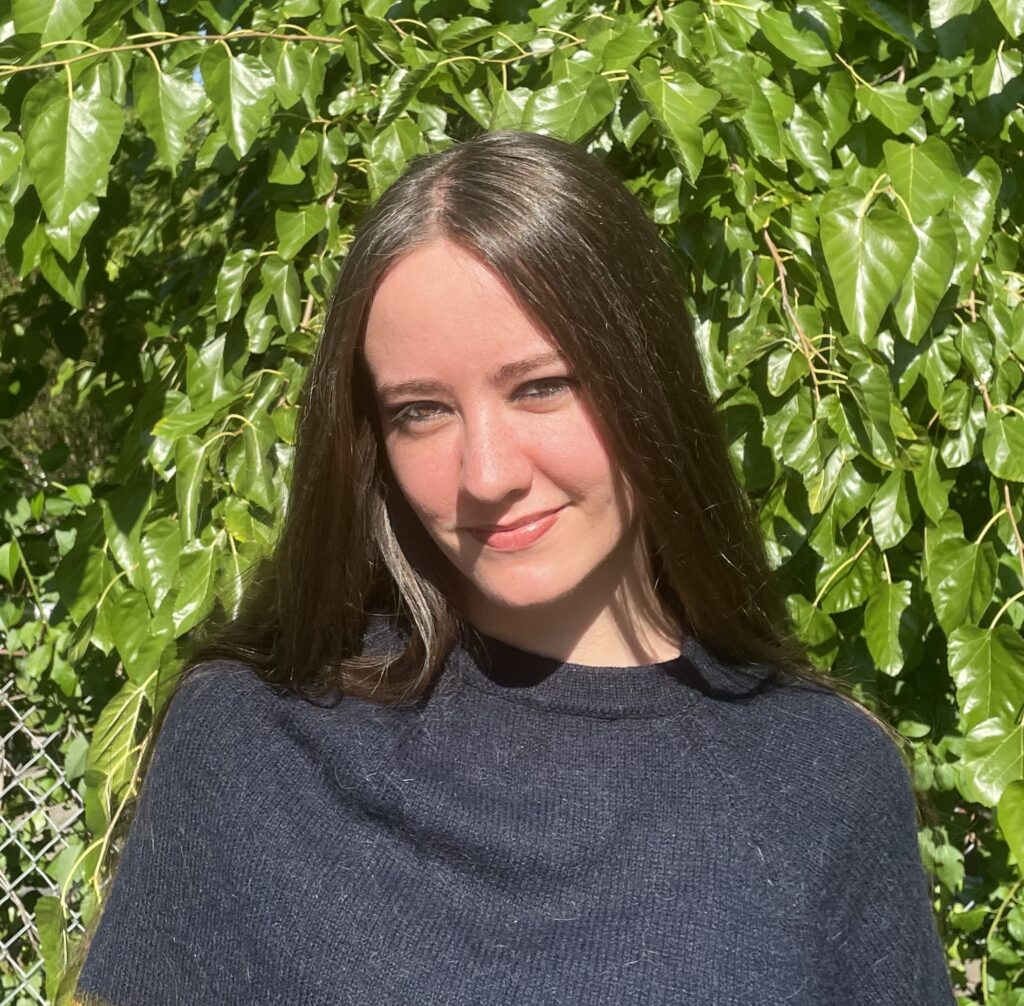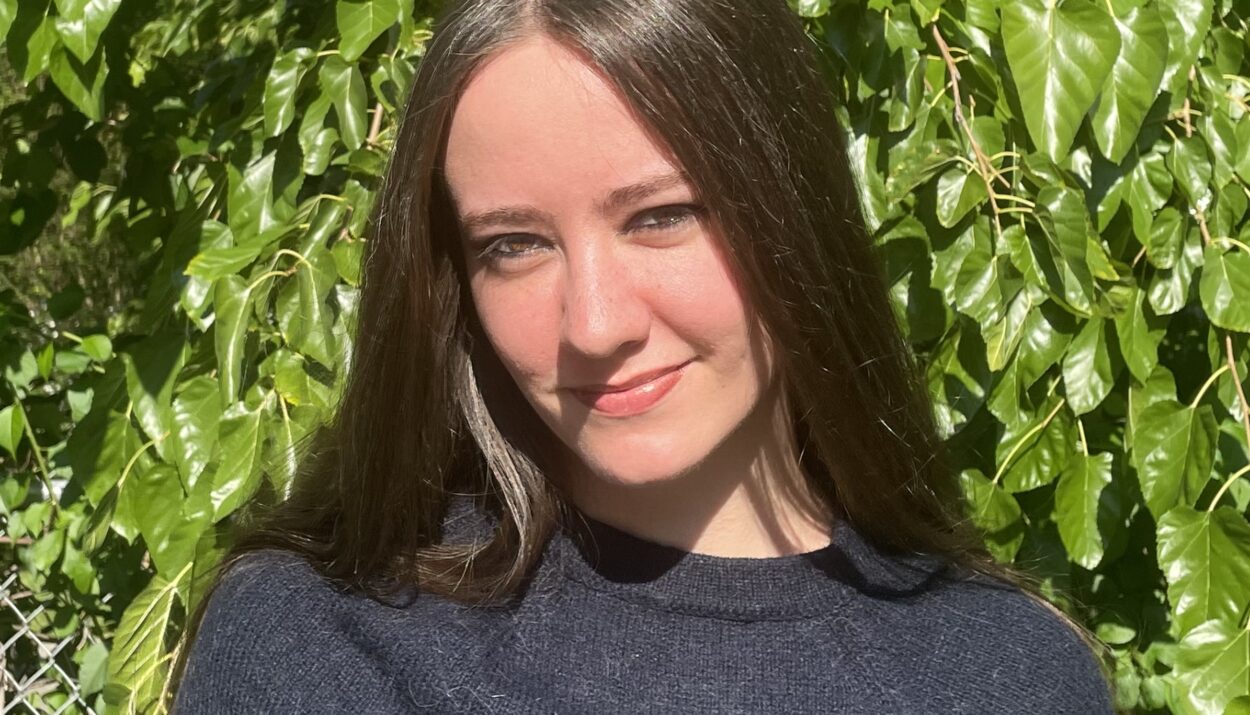
Welcome to the Ocean State Stories “family,” Grace! We discovered your work in LitArts RI, headed by our good friend Jodie Noel Vinson. Let begin with your background. Where did you grow up?
I grew up all over the country. I have a big family, and they’ve always been home to me. My mom homeschooled all five of us kids, focusing especially on philosophy, writing, and the Western classics.
When did writing first interest you?
My parents taught me to write at a very early age. My dad would hold writing competitions between me and my siblings, and we’d have to act out our stories and perfect our ability to read aloud (a lost art, my dad would say). My mom spent hours with us editing and refining submissions to the Scholastic writing competition. But what really fascinated me the most about writing was reading. My parents would always tell us that a good writer is a good reader. I loved English literature as a kid, and soon started sneaking into my dad’s library to spirit away copies of Dostoevsky my mother told me I was a little too young for. But it was when I discovered the Ancient Greeks that everything really changed – language became logical, not narrative; miniscule, not sweeping; and evocative in a way I had not yet encountered. I couldn’t argue with the feeling that there was something else, something undefined, in Socrates – so I decided I had to learn Ancient Greek, and see if I could find out what it was that had captured me.
Did you have any mentors?
My brothers were already taking a little Ancient Greek with an online, homeschool-adjacent, philosophy/geometry teacher named Mr. H. I was jealous that my brothers were in high school and I wasn’t, so I decided to do their philosophy, geometry, and Greek with them (my mom had always been enamored with the one room schoolhouse, and why not let the kid sit next to her brothers while they work?). I had heard about Mr. H for years, and eagerly awaited the day when I would be among his students. I went on to take five years of philosophy and the western canon with Mr. H, as well as ancient geometry and as much Ancient Greek as I could. I would be living an entirely different life if not for his encouragement and edification of quiet, nerdy kids with niche interests.
What about the schools you attended? We see on your LinkedIn page that you earned a bachelor of arts degree from St. John College and a mastersfrom the University of East Anglia. A little detail, please.
I went on to study at St. John’s College in Annapolis, Maryland (Mr. H’s alma mater). It’s America’s Great Books program, focused entirely on the Western canon. I continued my education in philosophy, literature, and the natural sciences, and tutored Ancient Greek to my peers. Ancient Greek was a required language for the freshman and sophomore years at St. John’s, and I managed a small group of student Greek assistants for the dean’s office. After nine years of Ancient Greek, I still had not cracked its mystery, or its hold on me. This language changed everything I thought I knew about writing, about language, even about history. Socrates made less sense to me at 22 than he did at 13 (and now, imagine my pitiable state at 26). After graduation, I went to Alaska for a year with my now-husband. I worked hard and I watched the mountains. I met a lot of people and worked with my hands. And I came to know that I feel the most at home between things – that Socrates was the most graspable in the act of translation – that Hegel was at the very least readable when you’re among friends – that the best way to think about and articulate myself was in the in-between space of Ancient Greek and English. I decided to study the theory of translation at the University of East Anglia in the UK for my masters. What was this nebulous space in between language and understanding that had confounded me from such an early age? How could I convey the strangeness, awfulness, wonderment that I felt in the act of translating and put it in writing?
My writing practice had become too complicated; I needed to know more about language, more about articulation, more about the potentiality and impossibility of saying what it is you want to say.The University of East Anglia didn’t answer my questions, and I’m glad for it. It’s hard to grow up classical and discover the post-modernists, and harder still to have to reread Plato because of that and realize you got it all wrong. (There’s a not-so-funny joke at St. John’s that after our senior year of Hegel and quantum physics, we need to take freshman year again.) UEA encouraged me to be radical, get experimental, dispense with the literary niceties for a moment so you can say what you need to say – and take the space to say it many times, in many ways, to wait to say it, to not say it at all.
You recently published a book of your own, Sappho: A Translating. Tell us about it.
It was at UEA that I refined my idea of multiple translation, which I first came up with while tutoring Ancient Greek at St. John’s. Sappho: A Translating is a translation of selected fragments of Sappho, an Ancient Greek, lesbian poet writing around 150 years after Homer. We’ve lost a lot of Sappho’s work over the centuries; about 650 lines of her poetry remain, out of a total 10,000.
I decided to translate 25 fragments of Sappho multiple times. I have seven iterations of Sappho’s fragment 130; none of them are remotely the same, and yet they are all bona fide translations ofthe original text. One iteration focuses on her Homeric allusions, another focuses on sound, another on rhythm, another on humor. I went into the project knowing that it is not an exercise; these multiple translations are not just examples of how words can mean many things at once. This is a curation that reflects the translator’s curational skills, and shows the reader a glimpse of the dark, voidless space that exists between articulations.
You live now in Rhode Island and are the publisher of Sun Thief Press, based in Providence. Please give us an overview.
I first spent time in Providence during my junior year of college. It was during COVID lockdowns, and my friends and I decided to all get an apartment and do Zoom school together in Providence (one of our friends is a hometown boy, and he will go nowhere else). We all fell in love with Providence, and left it unwillingly when school started up again. After graduation, some of us went to Alaska, some went home, some went to grad school right away, but we all wanted to end up in Providence again. After me and my husband finished school in the UK, we came back to Providence with our friends and started Sun Thief Press. It turns out my friends and husband are equally disturbed by articulation and its difficulties. We started Sun Thief to be a home for the exceptionally strange, post-post-modern writers/translators who push the boundaries of language and expectation. We want to publish work that questions itself, interrogates the writer and the writing, doesn’t let up, and reveals the strangeness (if you know Greek, the deinos) of experience itself. We publish one to two book-length titles per year, and a biannual literary journal, released on each solstice.
This statement appears on the site: “We are interested in work that blurs the boundaries between self and other, mind and world, writer and text.” Please elaborate.
Sun Thief Press was founded as a home for translators, but we accept original English language poetry, essays, and some fiction for our biannual journal, Sun Thief Literary Journal. As a translation-forward press, we want to publish work that still grapples with the broad questions of translation, even when it’s not a translated work per se. That means poetry and prose that deals in an aesthetics of exchange, passing-through, carrying-over – between binaries and apparent oppositions. We like literature that deals with the difficulties of communication, articulation, and interpretation.
We see Sun Thief Press as being in the tradition of the translator-writer, husband-wife duo Rosmarie and Keith Waldrop and their Burning Deck Press, a Providence-based publisher that ran from 1961-2017 and gained a reputation for publishing experimental poetry and prose. We deal with many of the same questions, themes, and aesthetics as they were.
What next for Grace Calk?
I’ll be editing and producing the inaugural issue of the Sun Thief Journal, which we’re hoping comes out on the Winter Solstice, December 21st. Besides that, I’m working on a fledgling project of found poetry in Ancient Greek lexicons (which consists of placing the many different meanings and uses for one word alongside each other in a lyrical way), as well as an illustrated Herodotus’ Histories for young teens. I am also translating a trio of Euripides’ plays, all adapted as one-woman shows, which I started at UEA with a one-woman adaptation of Medea.