
“A third of people in Rhode Island are food insecure.”
By Bonnie Phillips / ecoRI News staff
February 12, 2026
This story was originally published in EcoRI News, a publication partner of Ocean State Stories.
JOHNSTON — Rhode Island food and environmental advocates are launching a three-year effort to tackle two of the state’s most pressing and interconnected problems: the rapidly filling Central Landfill and reducing food waste.
Backed by a $750,000 grant from the Rhode Island Foundation, the Food & Climate Action Partnership seeks to reduce wasted food by increasing donations of surplus food to hungry people and building local leadership around food and environmental policy in five municipalities: Providence, Pawtucket, Central Falls, Newport, and Middletown.
The Rhode Island Food Policy Council (RIFPC), working with CET (Center for EcoTechnology), and FoodRecovery.org, will use the grant to fund a three-year program with the goals of strengthening civic engagement, reducing food insecurity, and lowering greenhouse gas emissions in Rhode Island by increasing the donation of excess food, increasing composting of food scrap, and lessening the amount of food being landfilled.
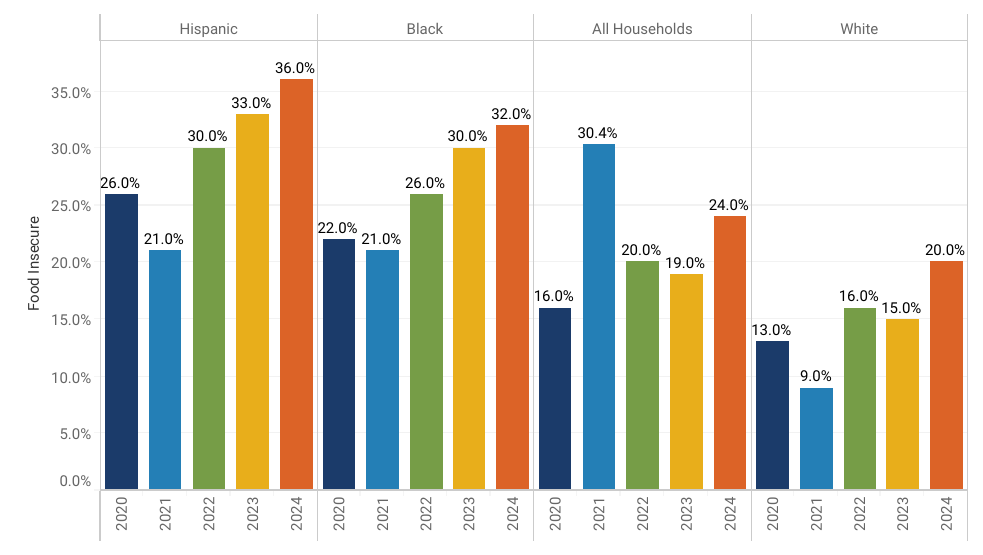
“A third of people in Rhode Island are food insecure,” said Isaac Bearg, food and climate program director for the RIFPC. The project, he said, is about “saving our landfill, feeding hungry people, and helping people become leaders” on food waste and policy in their communities.
The project “allows us to make short-term impacts while also working on medium- and longer-term solutions while getting food to people in need directly,” said Nessa Richman, executive director of the RIFPC who will also direct the new partnership.
Food insecurity
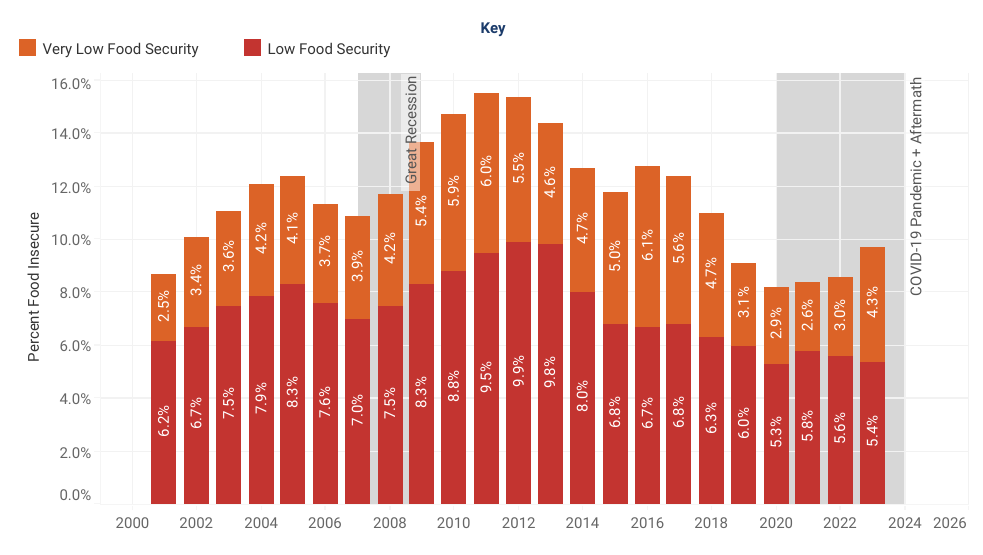
The U.S. Department of Agriculture defines food insecurity as the lack of consistent access to enough food for a healthy and active life. An average of 11.6% (more than 35,000) of Rhode Island households were food insecure from 2001 to 2023, according to the RIFPC. An average of 7.3% of food insecure households had “low food security,” which is defined as an experience of reduced quality, variety, or desirability of diet, during that time. An average of 4.3% had “very low food security,” which is defined as an experience of multiple indications of disrupted eating patterns and reduced food intake.
“Rhode Island boasts a thriving food system. However, amidst this prosperity, a stark reality persists; approximately 38% of residents grapple with food insecurity, underscoring systemic challenges exacerbated by climate change, racial injustice and health inequities,” Richman said.
The partnership seeks to divert some of the state’s wasted food — whether from restaurants, schools or businesses — to those who need it most.
“We wanted to engage upon a program that’s going to help people become leaders when it comes to reducing their food waste, and when it comes to making policy changes that are needed in their community, and then actually going out there and rescuing food to feed to hungry people,” Bearg said.
Allie Wilson, the Northeast director of operations for FoodRecovery.org, which connects food donors to nonprofits, described her organization’s role in the partnership as “taking the guesswork” out of the food donation process.
Many restaurants and food businesses, she said, still believe the “old wives’ tale” that if they donate food and someone gets sick, they will be sued. In reality, two federal laws provide strong liability protections: the 1996 Bill Emerson Good Samaritan Food Donation Act, which encourages donation of food and grocery products to nonprofits for distribution to individuals in need by protecting donors who give in good faith and the 2021 Food Donation Improvement Act, which expands and reinforces those protections.
“A lot of the things that kind of prevent people from donating food as well, especially small businesses, includes kind of logistical obstacles,” Wilson said. “Who’s going to pick up [the food] at 10 o’clock at night? Who’s going to drop it off at a church or a shelter or a food pantry? Which food pantry is able to do that? Which food pantry can even serve this food to their clients?”
That’s where FoodRecovery.org comes in, Wilson said. Its staff and drivers can coordinate pickups and deliveries, moving surplus food directly from businesses to nonprofits across Rhode Island.
“We kind of take that guesswork out of the equation for food businesses, because fortunately, we’ve been able to partner with a lot of different nonprofits throughout Rhode Island, and we’re able to take that food directly to those nonprofits with the assistance of our drivers,” Wilson said.
Another important aspect to the partnership, she said, will be outreach — getting the word out to businesses and organizations about donating excess food whenever possible.
“We’re really focusing on making sure that our outreach is as comprehensive as possible,” she said.
The initiative is, in part, an attempt to salvage and retool work that had been planned under an Environmental Protection Agency community change grant that was later terminated, Bearg said. The five participating communities were chosen because they contain some of the largest concentrations of environmental justice census tracts in the state.
“We just thought it was a good idea to continue to try to work and move that forward with some of the partners in the best way we could,” Bearg said.
Making change
The partnership chose the five municipalities on which to focus — Providence, Pawtucket, Central Falls, Newport, and Middletown — because they’re places in Rhode Island identified by the USDA as “low income/low access” (LILA) census tracts, where a large proportion of the residents have low incomes and are more than half a mile from a food source in urban populations. About 26% (64 out of 244) of census tracts in Rhode Island were deemed to be low income/low access by the USDA.
According to the Food Policy Council, when the LILA census tracts are sorted by race and Hispanic ethnicity, there is a strong correlation between the percentage of residents who identify as Black, Indigenous, and/or other people of color and low income/low access. Hispanic/Latino, Black, Asian, Indigenous, and Rhode Islanders of two or more races make up 31.3% of the state’s population, but 53% of its population living in LILA census tracts.
To work with these communities, Lorenzo Macaluso, chief growth officer of CET, a company that works with communities to foster sustainability and reduce food waste, explained, “We come at this from a climate lens, from our own mission and motivation, but really there’s so many different benefits, economically, socially and environmentally, that we take an approach of listening first.”
The partnership will work with the communities on supporting leadership and policy change to help reduce food waste.
“There are goals in terms of engaging community leaders,” Bearg said. “That’s something the Food Policy Council is really going to be focused on because, unfortunately, as fantastic of a program as this is, it won’t solve all of the problems, and we need a lot of different changes, from policy down to just awareness and education.”
Bearg said that includes teaching program participants how state and local policy works; equipping them to advocate for better food waste, donation, and composting policies; and ensuring that residents in environmental justice communities have a voice in long-term solutions.
“We’ve had people go, ‘Oh, I didn’t know I could even go in the Statehouse.’ So, it’s literally training people on what this whole process is about and how they can get engaged,” Bearg said. “This is a fantastic program, but it won’t solve all the problems. We need changes from policy down to awareness and education.”
Food waste
At a time when one in every nine Rhode Island households is experiencing food insecurity, about 80,000 tons of food is buried in the Central Landfill annually. According to the Natural Resources Defense Council, food waste is the top component in our nation’s landfills, and costs families $165 billion each year.
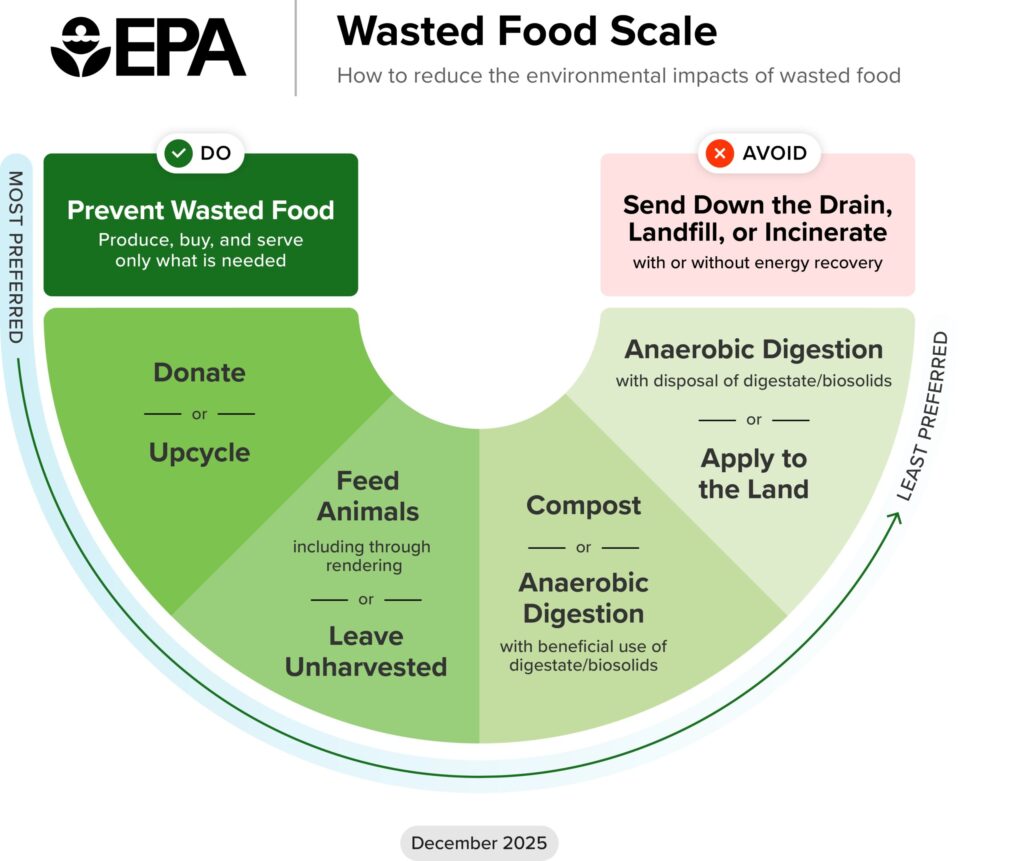
The Food & Climate Action Partnership’s effort is structured around the EPA Wasted Food Scale, a hierarchy that ranks options for dealing with surplus food. According to the EPA, the best option is source reduction, or preventing waste in the first place, followed by donating safe, edible food; using leftover food to feed animals; eliminating the wasted food through industrial means such as anaerobic digesters or composting; and the least preferred option, landfill or incineration.
Macaluso emphasized that real-world situations can be more nuanced than a simple diagram. For example, it may be better environmentally to feed animals locally than to truck donated food hundreds of miles away. But the hierarchy provides a clear, guiding framework: prevent, donate, then manage what’s left as sustainably as possible.
“We’ve been in literally hundreds and hundreds and hundreds of businesses, and can help quickly identify the best opportunities, the most prevalent types of food, materials that might be getting wasted, and then make recommendations that include prevention strategies, the donation … and then either composting or animal feed or anaerobic digestion, depending on where they are and what their material types are,” Macaluso said.
“We want to work with as many of the leaders in these communities as possible to get the message out right,” he added.
Bearg said that in some cases, “folks in these areas are already thinking about these things. They may just not know that there’s resources available to help them take the next step. And so we want to make sure that they are aware, and then we go out and actually provide the services.”
Macaluso said when working with businesses, CET staff present options across the EPA hierarchy and let owners choose where to start. Often, they said, a business that begins with composting eventually realizes it is throwing away perfectly good food and moves up the ladder to donation and prevention.
Many larger retailers are already partway down this path. For example, Stop & Shop deals with its food waste in a number of ways, according to both Wilson and Macaluso.
The company has an anaerobic digestion system at one of their distribution centers in Massachusetts, Macaluso said, where they take some of the wasted food.
“So when they come with a truck full of product to the store, they unload it, and then they haul food scraps to this facility where it goes through what’s called a de-packaging piece of machinery that takes apart the packaging from the food, and the food goes through anaerobic digestion,” which creates renewable energy and partially pays for the electricity to run the refrigeration, Macaluso said. “So they have a pretty sophisticated system going on.”
“Of course, we’re always going to reach out and double check and say, you know, hey, we hear that you’re donating to the food bank. That’s great. What other ways could we help out? If there’s a day where the food bank can’t get the food, we would love to help out then, or if there’s any food that maybe the food bank can’t necessarily handle,” Wilson added.
That goes for restaurants too, Macaluso said.
“If you’re a restaurant, you want to make a great meal and have your patrons come back. Food waste is probably not second, third, fifth or even eighth on your list, so part of our goal here is to make this easy for them, help them see the path in the most easy lift so that they don’t have to figure it out from scratch, that all those connections can be made for them,” Macaluso said.
“If we can feed the hungry people, if we can save people money, it’s also really going to benefit the environment,” Bearg said.