“It’s like a celebration. This is how I’m interpreting the spirit of this person, so that spirit continues to live.”
CRANSTON — Local artist Tamara Kaplan remembers many things about her father, Stanley. The practical jokes he’d play on her teenaged suitors. His unexpected sense of color. His willingness to try anything if his daughters asked.
But one of the things that they shared was an appreciation for quietude. “We could sit in the car for hours and just be in our space, not talking, and there was no weirdness about it,” Kaplan said.
Soon after her father died of Parkinson’s in 2021, Kaplan found in his bureau a single yellow post-it note, on which he had striven to write her mother’s name, Judy, in cursive unsteadied by his illness.
“It had taken him four tries to write her name,” she said. “It just hit me: this was sort of like his love letter to my mother.”
Kaplan knew the note would inspire artwork about her father. But — aptly, given their shared appreciation for solitude — it took the quiet of an artist’s residency for the project’s form to reveal itself: a series of brightly-colored linocut prints, titled “Project: Judy,” that render these snippets of devotional writing in bright colors and playful angles, the letters so large that they approach abstraction.
“It’s like a celebration,” Kaplan said. “This is how I’m interpreting the spirit of this person, so that spirit continues to live.”
One of these prints — a four-paneled piece titled “Judy in Space” — is among the 17 artworks composing “In Memory Of,” the Cranston Arts Commission Fall Gallery on display until October 27 at the Cranston Central Library at 140 Sockanosset Cross Road. Presented in partnership with the Cranston Historical Cemeteries Commission, the show is the most recent Rhode Island arts programming — which also includes conversation cafes, immersions, and open-mics — exploring death, grief, and loss.
With a record number of submissions — each holding deep personal meaning for its artist — this year’s selection process was challenging, said Danielle Izzi, Secretary of the Cranston Arts Commission and the fall gallery’s commissioner.
“It really was a matter of finding the pieces and stories that spoke to each other the most,” Izzi said. “It was really beautiful to see the different ways people interpreted the theme.”
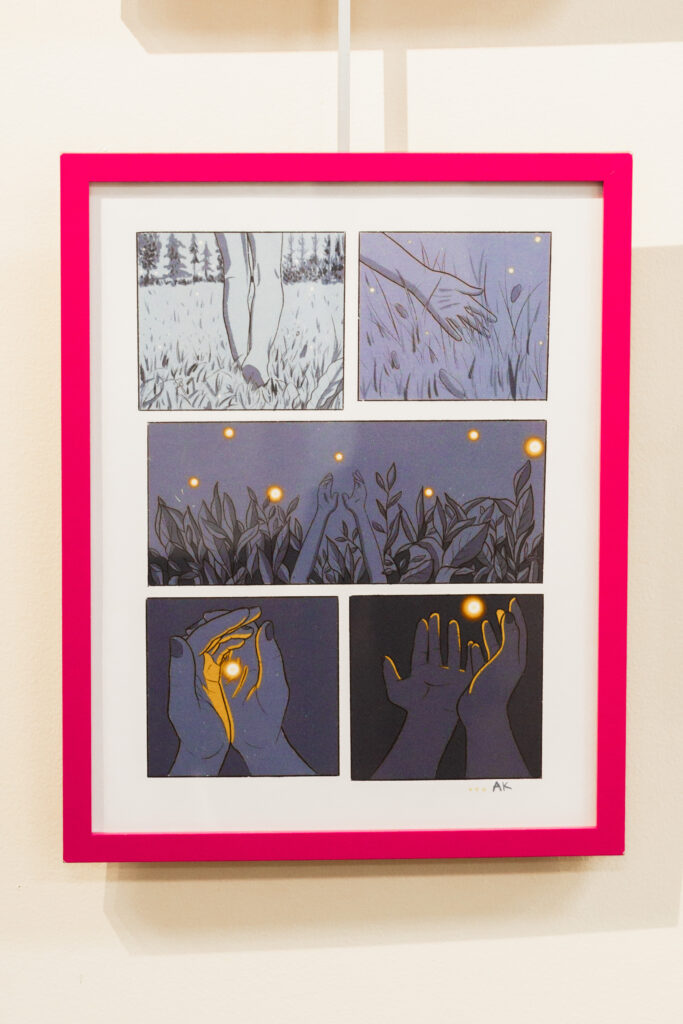
Some pieces in the show, like Kaplan’s “Judy in Space,” draw inspiration from personal loss. Others memorialize lost places. For example, Kevin Savoie’s “Closing Sale” — a collage made with carved foam, paint, and old sale flyers — mourns Jo-Ann Fabrics, the craft store whose Warwick location now houses a mass-market holiday goods shop. Others memorialize lost moments in time. Amanda Kryla’s digital illustrations — each modeled after a comic book page — capture the fuzzy edges of childhood memories. Her whimsical “Seeds” depicts an accidentally eaten watermelon seed that sprouts a full-grown gourd in a child’s belly, while “Pretty Lights” features fireflies swirling in grass and captured briefly in two cupped hands.
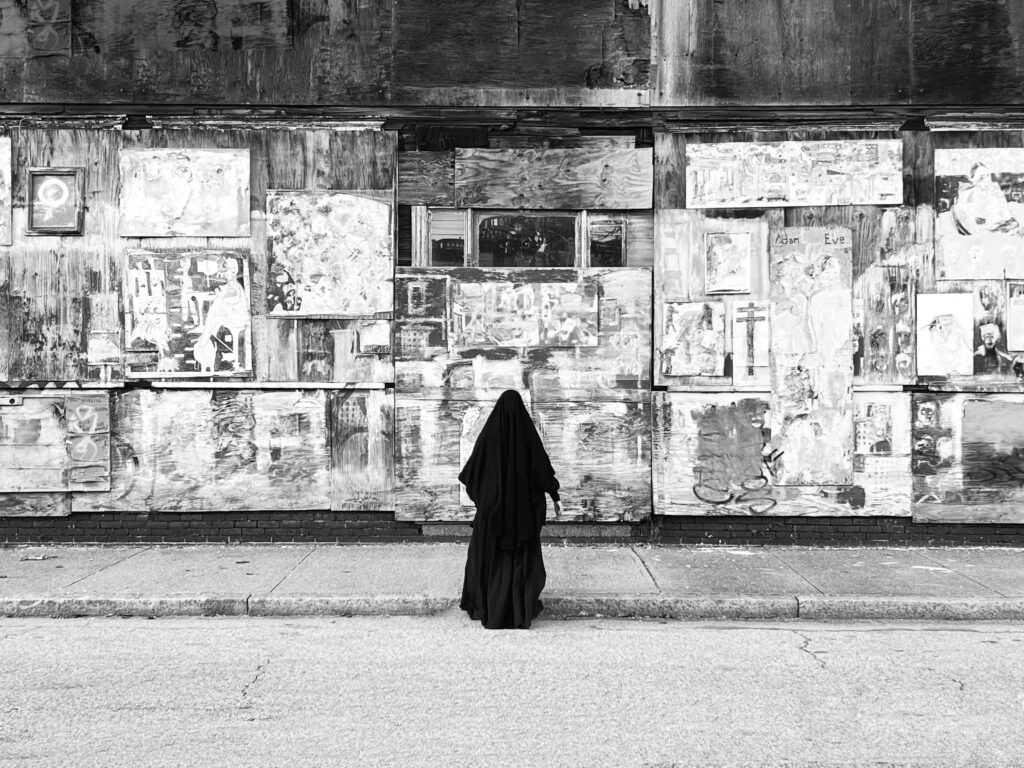
Still others give form to collective grief. Photographer Jay Davani’s “Witness” series features nine black-and-white self-portraits; in each, Davani visually recreates the death of a different person who lost their life during Iran’s most recent revolution. In the process, she becomes a witness herself to these acts of violent loss.

“I just felt so paralyzed by what was happening and my inability to do anything to help,” said Davani, who was born in Tehran and raised in the United States. To counter this feeling of powerlessness, she turned to art: “I had to give a voice to the voiceless, and the only way to do that is to get people to see.”
Creating the photographs in the series took an emotional toll on Davani. The process of meticulously researching and physically recreating each death “was deeply painful,” she said.
Still, she continued. “It felt so unbelievably important… It was the only way that I could have an impact while processing how I was feeling about it all.”
A desire to turn powerlessness into action also inspired Mikaela Joyce, a Providence-based artist whose reactive collage, “Bambi’s Mom,” mourns those lost to the United States’s gun violence epidemic. “With this issue, sociopolitically, I feel very helpless,” she said. “A lot of this piece was me processing the chaos, tragedy, and insanity that surrounds it.”
Joyce expressed hope that the artwork assembled in the “In Memory Of” show offers solace to visitors processing their own forms of loss. “Grief is a universal experience — we’ve all lost someone we loved — and there’s so many ways to explore that,” she said. “I hope the exhibit makes people feel seen, or helps them process things that are really complicated or painful.”
Breathing New Life into Memorialization
To the untrained eye, Mary Sheldon Arnold’s centuries-old headstone — which resides in the Nicholas Sheldon lot, one of 167 historical cemeteries that the all-volunteer Cranston Historical Cemeteries Commission seeks to restore, maintain, and document — may look unremarkable. But for John Hill, the commission’s chairperson, its sparse details offer a portal to a deeply human story.
“It says she died in 1804, on the 25th of May,” he said. “And right next to it is another Mary Sheldon Arnold, and her birth date is her mother’s death date. So the woman died in childbirth.” She was just 18 or 19 years old; her infant daughter died a month later.
But what’s most remarkable for Hill is the tombstone’s inscription. “Usually there’s just the name and the date, and maybe a sing-song poem,” he said. “But this one had this poem of grief and rage — and it’s long, which would have been expensive.”
Thus, another figure — that of a heartbroken widower — takes shape, and a complex human story begins to emerge.
Hill can spot these stories embedded in dates and manufacture details, but the emotional richness behind these historical facts is not always accessible to the general public.
“The Commission’s main approach makes it kind of a history lesson,” Hill said. “We wanted to partner with someone who could come at it from a completely different perspective, who would show us something new.”
The cemetery commission found what they were looking for by partnering with the Cranston Arts Commission on the “In Memory Of” gallery.
“The artists have tapped into the emotional context of what we do [at the Cranston Historical Cemetery Commission],” Hill said. “That could be a powerful tool to get people to think about the past not just as a series of events, but as people living in the world.”
In turn, the cemetery commission’s involvement has allowed the Cranston Arts Commission to coordinate a series of events — from lectures to Q&As to interactive artmaking workshops — that highlight the ways memorialization connects particular historical detail to shared human experience.
“We wanted to place more elements of the history and culture of death, dying and cemeteries in tandem with artistic opportunities,” Izzi said. The resulting program is the art commission’s most expansive yet: “We decided, we have the capacity, we have the interest, so let’s go for it.”
For the first event, Davani led “Mortality, Meaning and the Art of the Good Death,” a lecture and Q&A held on October 1 at William Hall Auditorium, located at 1825 Broad St. in Cranston. At the event, Davani — who, in addition to her photography, heads Studio Mortem, a community-based initiative that cultivates healthier relationships with death — offered insight into her work and art before taking questions from the packed auditorium. Topics ranged from the death penalty and the recent specter of public executions to methods of interment and different cultural approaches to death and dying.
“It was all over the place in the best way,” Davani said.
In “Headstones: A History,” held at Cranston Central Library on October 10, Hill shared historical insight into the materials, motifs, and inscriptions that commonly arise in Rhode Island’s historical cemeteries — the types of insights that can transform a nondescript tombstone like Mary Sheldon Arnold’s into a site of human connection across centuries. After the talk, attendees were encouraged to participate in a self-guided scavenger hunt at one of the city’s historical cemeteries.
Hill also joined Abbey Rondeau-Tellier, an artist and member of the Cranston Arts Commission, for a block printing workshop at William Hall Auditorium on Thursday, October 15. Inspired by reproducible symbols — such as angels, ships, crosses, and halos — that appeared on memorials in the late 19th and early 20th centuries, this workshop invited participants to create their own memorial symbols using rubber stamps, which they used to decorate a keepsake memorial wood block.
This workshop will be followed by another interactive event on Saturday, October 17. From 10:00 a.m. – 11:30 a.m. at the Cranston Central Library, Marta Martinez will lead “Day of the Dead Altars: History and How to Make Your Own.” Martinez — who is executive director of Rhode Island Latino Arts — will share the history of El Día de los Muertos (or Day of the Dead), a celebration day observed in Mexican and Latin American cultures, which honors dead beloveds and welcomes their spirits’ returns. Participants will then create their own El Día de los Muertos ofrendas, small altars commemorating loved ones who have died.
The events will conclude on Wednesday, October 21, with a cemetery tour and photography walk at Oakland Cemetery, located at 1569 Broad St. in Cranston. The walk will be led by Davani and Lexie Ludovici, a docent at Providence’s North Burial Ground. Participants will meet at the cemetery at 5:30 p.m. After learning rituals for entering the cemetery’s sacred space, they will be invited to take photographs of the cemetery as the lighting shifts from sunset to dusk. “We are going to be playing with light and dark,” Davani said. “Everyone is encouraged to bring their cameras and flashlights.”
Oakland Cemetery provides a poignant place to close the events surrounding the “In Memory Of” gallery show. After years of lapsed stewardship left the cemetery’s grounds in disrepair, local volunteers have stepped up to restore the space — but they’ve preserved the many colorful memorials that families have left at their loved one’s gravesites over the years. From lit lanterns to favorite toys to bright artificial flowers, these items celebrate the lives and loves of the people buried there.
It’s a celebration of spirit — colorful and deeply personal — that recalls the one animating Kaplan’s commemorative linocut prints.
“I always say we stand on the shoulders of our ancestors,” Kaplan said. “We take people who have meant something to us and we hold them close. We always hold them close.”
Shedding Fear, Embracing Life
Elsewhere in Rhode Island, artists and performers are facilitating ongoing dialogs, immersions, and performance spaces for community members to consider death — and, in the process, find deeper joy in their present lives.
As founder of Studio Mortem, Davani offers programs that enable community members to explore death, grief, and loss so that they are better able to process these experiences in their own lives.
“I’m not trying to remove the pain or the suffering that comes with loss,” she said. “If things weren’t painful, they wouldn’t be precious … My goal is to help people develop foundations before these moments arise, so that they can process those feelings and still be present here.”
To do this, Davani’s events center participant engagement. “When I invite an audience to be part of the experience, it allows people to connect more deeply with the topic, and it spreads once it leaves that space in a far deeper and greater way.”
Since May 2023, Davani has hosted Death Cafes — open dialogs that offer participants a compassionate space to discuss death and dying. Sponsored by the City of Providence and Community Libraries of Providence (CLPVD), these events take place monthly at various libraries in the CLPVD network and are free to the public. To ensure all participants have the opportunity to participate, the number of attendees is capped at each event; prior registration is required, and the events typically fill within minutes of tickets becoming available.
This winter, Davani will also be relaunching “The Edge of Being,” a 90-minute immersive experience that guides participants through a process of ritual, meditation, and light restorative movement to explore the threshold between death and rebirth. Aided by guided sensory experiences — including scent, sound, and light touch — participants are invited to explore and release fears about death and loss to create deeper capacity for life.
“I started the immersions out of a desire to have an experience that is felt rather than spoken,” she said. “Someone who might be afraid to talk about death may be open to just going on a journey.”
Davani has led three immersions at The Love Offensive Hot Yoga Studio, located at 60 Valley St. in Providence, with dates aligning with seasonal solstices and equinoxes. Each one sold out — with some people attending all three.
“They say that every single time they come out with a slightly different depth to the experience,” she said.
Elsewhere in the Providence area, Siobhan Doherty’s Death Salons provide a shared stage for community members exploring death and loss through performance arts.
Doherty — a creativity coach, joy facilitator, and performance artist — launched Death Salon in spring of 2023 with support from the Rhode Island State Council on the Arts. This fall, the salons will begin running every six weeks, with the next taking place on November 1 at 6 p.m. at Myrtle, located at 31 Waterman Ave. in East Providence. (Sign-ups will begin at 5 p.m.)
“There are no rules about what you can bring — it can be a song, a poem, a story, a magic trick, a dialog with the audience,” Doherty said. “It’s really a space for sharing something without having to qualify it, or worrying about what other people think about it, or having to be perfect.”
A Bay Area native, Doherty drew inspiration for Death Salon from You’re Going to Die: Poetry, Prose, and Everything Goes…, a long-running open mic series based in San Francisco. “Every time I would go, I would feel so transformed because people were sharing things that were so near and dear to them,” she said.
For Ceridwen McKenna, a local writer and healer who has participated in Death Salon since it began, the events offer an opportunity to surface the grief experiences that people often bury.
“As a healer, I deal with a lot of people who have bisected, trisected, quadriscected their lives: this is work, this is home, this is death, this is life, and this is not, and this is that,” she said. “But the human experience can’t be cut into pieces, especially when you’re grieving.”
By sharing grief, salon participants deepen their capacity to experience life, Doherty said: “Ironically, when you talk about grief, loss, and death, it really recenters you into what is most important about life — and that fact that we are still here and we are still alive.”
Davani sees a similar effect arise for participants in her Death Cafes and immersion experiences.
“Through these experiences, people develop a better understanding of the finite nature of life, which results in a deeper appreciation for life,” she said. “It makes them actually feel more alive.”