
“We do not want — and will not allow — Providence’s public property to be used to execute what we see as unlawful immigration enforcement.”
This story was originally published in Rhode Island Current, a publication partner of Ocean State Stories.
PROVIDENCE — City property — including parking lots, public schools, parks and municipal buildings — is off limits to federal immigration officers conducting enforcement operations, under an executive order signed by Providence Mayor Brett Smiley Tuesday.
Smiley told reporters gathered at City Hall that U.S. Immigration and Customs Enforcement (ICE) operations in other blue cities made the order necessary to protect the community. He said he was unaware of any ICE actions on city property since the second Trump administration took over one year ago. However, immigration officers entered the state-owned Garrahy Judicial Complex on Dorrance Street on Jan. 15, bypassing security and prompting outrage from state leaders.
“We’re taking clear action to affirm Providence’s values,” Smiley said before signing his first executive order of the year with a black pen. “We do not want — and will not allow — Providence’s public property to be used to execute what we see as unlawful immigration enforcement.”
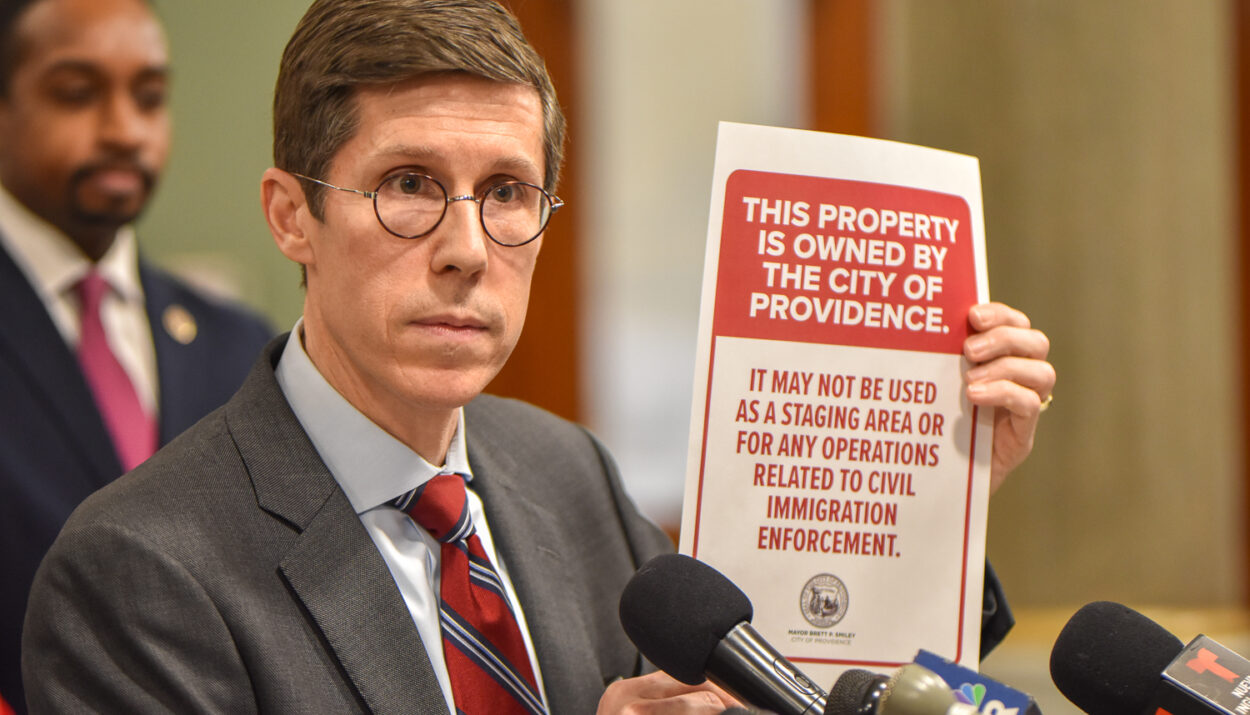
Smiley held up a copy of a red sign city employees will post noting the use of city property as a federal immigration enforcement staging site is now prohibited. In the event ICE officers are seen on any city-owned property without a judicial warrant, Smiley said Providence police will be required to vacate the federal agents from it.
“If Immigration and Customs Enforcement presents a valid judicial warrant, we will honor it,” the mayor said. “We honor it today, but the reality is that’s not what’s happening in most instances.”
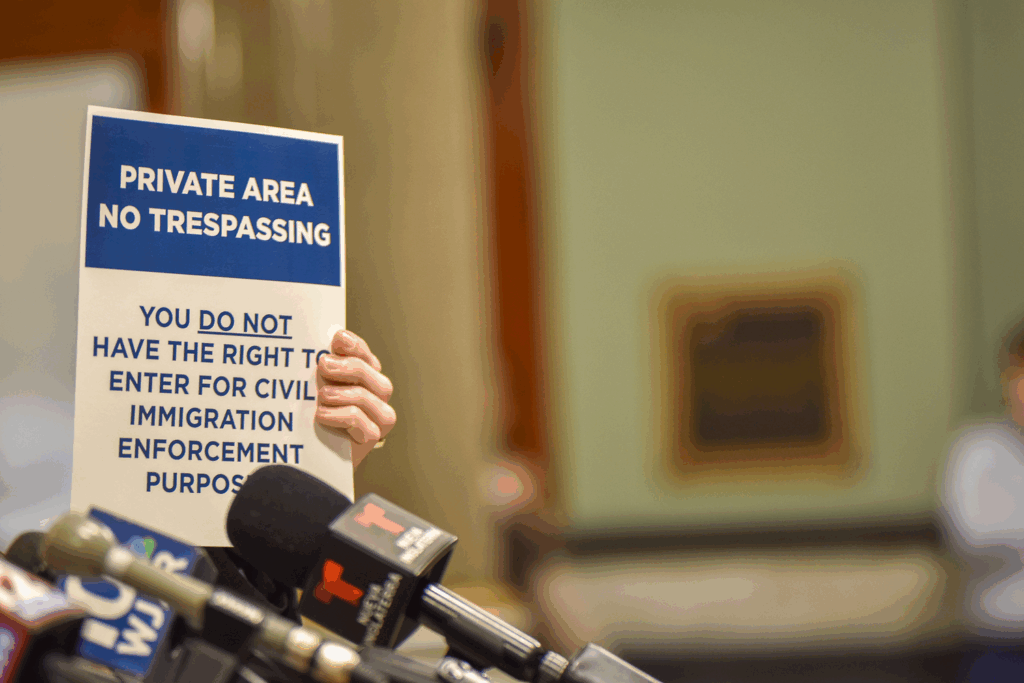
Private property owners are welcome to go to the city’s website and download and print out the signs to identify “non-public areas of their property” where ICE activity is prohibited, according to Smiley’s executive order. Property owners can use signs “at their own discretion and assume any legal risk associated therewith.”
Smiley said he has been encouraging the state’s judicial branch to enact a similar policy and also expand the use of virtual court hearings in Providence to discourage additional ICE visits.
The Jan. 15 incident at the Garrahy Courthouse was the second time in three months that ICE officers entered a state courthouse. ICE officers briefly detained a teenage judicial intern outside of the Licht Judicial Complex in Providence on Nov. 20, sparking condemnation from state and local officials, including Gov. Dan McKee and Chief Justice Paul Suttell.
ICE did not immediately respond to request for comment on the Jan. 15 incident.
The Providence Journal reported “several” masked immigration officers ran through the first floor of the Garrahy Courthouse in pursuit of two young men though apparently did not take anyone into custody.
“Allowing these barely-trained and reckless federal agents to blunder through our state, disrupting the justice system and harassing children and judges, diminishes the safety of our citizens and undermines the efforts of real law enforcement officers,” Lt. Gov Sabina Matos said in a Jan. 16 statement. “I am glad that this incident appears to have ended without harm to anyone, but we have all seen how this behavior leads to tragedy. ICE needs to be reined in and subject to the same laws that govern us all.”
The Judiciary enacted rules for virtual court hearings in 2021 amid the COVID-19 pandemic and recently posted its revised policy for requesting such a hearing using an online form. A judicial officer makes the final determination on whether the hearing must be held in person or not.
“As has been the case since the Judiciary developed remote hearing access capabilities, members of the public may request that a pending hearing be conducted remotely,” Judiciary spokesperson Lexi Kriss said in a recent email to Rhode Island Current. “These requests are to be submitted to and considered by the judicial officer presiding over the matter.”
Smiley’s order follows a move by city officials in November to amend Providence’s Community-Police Relations Act to deter local police from interacting with federal immigration officers.
Smiley acknowledged his order may put Providence further in the Trump administration’s crosshairs. The president on Jan. 14 threatened to halt federal funding to so-called “sanctuary” cities and states starting Feb. 1 if they don’t honor his mass deportation policies.
But Smiley said the fear of federal retribution is outweighed by the need to let Providence residents know the city has their backs.
“There are families in Providence who are afraid,” he said. “My responsibility is to them, not anyone in Washington D.C.”