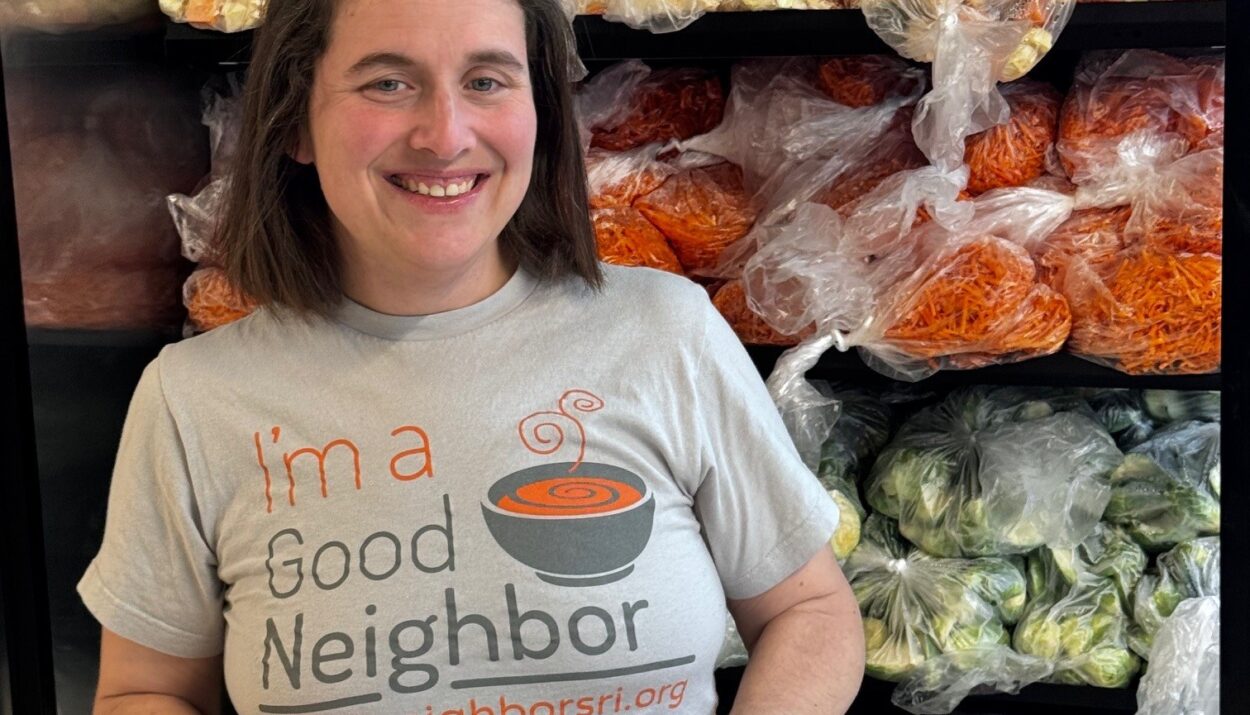

Thanks, Kate, for agreeing to bring the great work of Good Neighbors to out audience. Before we start, let’s take a moment to acknowledge the terrible tragedy over the weekend at Brown University. Surely many of the people you serve have a connection to Brown, as do we all. Our thoughts and prayers go out to the victims, their families and the community.
Let’s begin with an overview of Good Neighbors. Who does it serve and where do they live?
I first want to respond to that acknowledgement – we currently host an intern and have volunteers who attend Brown, along with volunteers who work at Brown. Our thoughts are with all of the students and families wo have been impacted by this senseless act.*
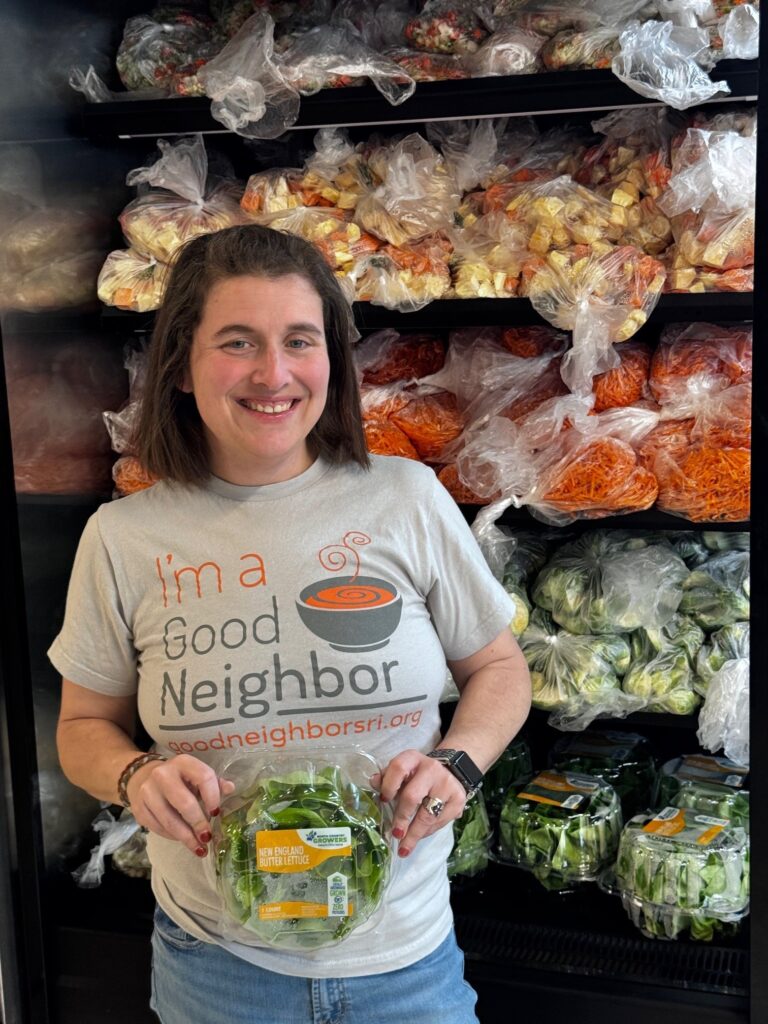
Good Neighbors is a hunger relief organization that serves individuals and families experiencing food insecurity in Rhode Island. The majority of the people we serve live in the East Bay and Providence Metro area, though our doors are open to anyone in need.
Our work is centered around two core programs. The first is our Food Pantry, which provides access to nutritious groceries in a welcoming, dignified setting. Guests can select food that meets their household needs and preferences, helping to supplement tight food budgets and close gaps left by SNAP and other assistance programs.
Our second program is the Community Kitchen, where we serve free, prepared meals throughout the week. These meals are open to anyone in the community and provide not only nourishment, but also a space for connection and community. Many guests rely on both programs, using the pantry for groceries and the kitchen for consistent, ready-to-eat meals.
Our guests include working families, seniors on fixed incomes, individuals living with disabilities, unhoused individuals, and people facing temporary financial hardship. Many are navigating rising housing, utility, and food costs, and turn to Good Neighbors to help fill the gap. In addition to providing food, we focus on creating a welcoming, dignified environment where everyone who walks through our doors feels respected and supported.
Your website states that “as many as 30% of East Providence households are likely to experience food insecurity at least once a year. Most experts project an increase in food insecurity over the next year if not longer.” What are some of the factors behind these distressing statistics?
In 2024, Good Neighbors directly served 4,181 unduplicated individuals through our Food Pantry and Community Kitchen programs. In 2025, that number increased to approximately 4,750 unduplicated individuals, reflecting a continued rise in need across our community.
This increase aligns with broader trends in food insecurity, where as many as 30% of East Providence households experience food insecurity at least once each year. Several factors are driving these distressing statistics. Housing costs continue to rise, leaving families with fewer resources for food after paying rent and utilities. Food prices remain high, while SNAP benefits and other assistance programs often fall short of covering monthly needs.
We are also seeing a growing number of working individuals and families seeking support. Many people are employed but earn wages that have not kept pace with the cost of living. Seniors on fixed incomes and individuals with disabilities are especially vulnerable, as their incomes remain stable while expenses increase.
The year-over-year increase in the number of people we served underscores the reality that food insecurity is not a short-term issue, but an ongoing challenge for many households. Good Neighbors plays a critical role in helping to close this gap by providing consistent access to nutritious food and a welcoming community space.
Are these households from many backgrounds?
Yes—very much so.
The households we serve come from a wide range of backgrounds, reflecting the diversity of the communities around us. Our guests include people of different ages, races, cultures, family structures, and life circumstances. We serve working families, single parents, seniors on fixed incomes, individuals with disabilities, college students, and people experiencing temporary crises such as job loss, illness, or housing instability.
What unites these households is not a single background, but the reality of navigating food insecurity. Importantly, every household we serve has its own story—full of challenges, resilience, and hope. Some are experiencing a short-term crisis, while others rely on our programs more consistently. At Good Neighbors, we strive to honor and respect these stories by creating a welcoming environment where everyone is treated with dignity.
Our goal is to ensure that anyone who comes through our doors feels seen, valued, and supported—because each person’s story matters and contributes to the richness of our community.
You welcome donors, correct?
Absolutely. Donors are a vital part of Good Neighbors’ work. We welcome individuals, families, corporations, and foundations who want to support our mission. Many donors not only provide financial support but also contribute in-kind donations—such as food or supplies—which help us serve our community more effectively and stretch our resources further.
We also value donors who engage with our programs directly, whether by volunteering in the pantry, helping in the Community Kitchen, or participating in special projects like our community garden. We make it a priority to ensure donors feel connected to the impact of their support. Through tours, volunteer opportunities, and regular updates, donors can see firsthand how their contributions help feed neighbors in need, foster community, and bring dignity and joy to those we serve.
Please tell us about Food Pantries and Dine-in & To-go meals.
Good Neighbors offers two main programs to help address food insecurity: our Food Pantry and our Dine-in & To-go meals.
The Food Pantry provides guests with access to nutritious groceries in a welcoming, dignified environment. Guests can select items that meet their household needs and preferences, allowing them to stretch their food budgets and supplement other assistance programs. This program serves individuals and families experiencing both short-term and ongoing food insecurity.
Our Dine-in & To-go meals are prepared on-site in our Community Kitchen and available to anyone in the community. Guests can enjoy a free meal in a welcoming space or take meals to go if they prefer. These meals not only provide essential nourishment but also create opportunities for social connection, reducing isolation and fostering a sense of community.
Together, these programs allow Good Neighbors to address hunger in multiple ways—offering both groceries for home use and prepared meals for immediate needs—while creating a supportive and inclusive environment for everyone who visits.
Your website states: “Good Neighbors is a volunteer-driven organization. We simply couldn’t do this work without the dedication of our many wonderful volunteers! It is a great place to get involved in your community in a fun and meaningful way.” Can you expand on this?
Absolutely. Volunteers are truly the backbone of Good Neighbors. Across our two locations, we are supported by two staff members and more than 130 dedicated volunteers. From sorting and distributing groceries in our Food Pantry, to preparing and serving meals in our Community Kitchen, to planting and maintaining our community garden, volunteers contribute countless hours that allow us to serve thousands of people each year.
What makes volunteering at Good Neighbors special is that it’s not just about helping—it’s also about connection. Volunteers often develop relationships with guests, with other volunteers, and with our staff. They see the direct impact of their efforts, whether it’s a guest leaving with a full bag of groceries, a warm meal, or a bouquet of flowers from our garden.
Our volunteers come from all walks of life—students, retirees, corporate groups, families, and individuals—and each brings their own skills, energy, and perspective. Many stay engaged year after year because they find the work meaningful, rewarding, and even fun. We also make a point of creating opportunities that are accessible to volunteers of all abilities and experience levels, so everyone can contribute in a way that feels satisfying and impactful.
In short, volunteers are not just helping us run programs—they are part of the heart and soul of Good Neighbors, and their dedication allows us to make a real difference in our community every day.
And volunteers do not have to be East Providence residents, is that right?
That’s correct! Our volunteers come from all over Rhode Island and beyond. We welcome anyone who wants to get involved and support our mission, regardless of where they live. This allows us to bring together a diverse group of people—students, retirees, corporate teams, and families—who all contribute their time and energy to help our community.
The pause in SNAP benefits earlier this year highlighted the struggles many go through just to eat — let alone find or keep housing, obtain healthcare, and pay other bills. Do you find that these struggles continue as we head into winter?
Yes, these struggles continue and often intensify during the winter months. While the SNAP pause earlier this year brought national attention to the challenges families face, for many people in our community, food insecurity is a year-round issue. Rising heating costs, utility bills, and other winter expenses can make it even harder to stretch limited budgets, forcing difficult choices between food, housing, healthcare, and other essentials.
Our programs at Good Neighbors remain a critical safety net during this season. Guests rely on our Food Pantry and Dine-in & To-go meals to fill gaps and ensure that they and their families have access to nutritious food. The winter months often bring increased demand, and we see firsthand how essential consistent support is for maintaining both physical health and a sense of stability for people facing financial challenges.
I’d like to state the values that Good Neighbors holds.
— We believe that access to food is a human right.
–We believe in the importance of building community.
— We treat all people with respect and dignity.
— We aim to maximize our guests’ ability to choose what food they need and how they access it.
— We rely on the power of volunteers to achieve our mission and to increase our ability to serve the community.
— We make no judgments of people.
— We believe the role of volunteer is a rewarding expression of caring and community open to all.
Please tell us about the personal journey that led you to Good Neighbors. We see on your website that you grew up in East Providence, graduated from Rhode Island College, and served in the Peace Corps.
After graduating from Rhode Island College, I spent some time working in retail management, which taught me valuable lessons about leadership, organization, and working with diverse teams. I then served in the Peace Corps in Eswatini from 2015 to 2018, and stayed for three more years working with a community-based organization focused on child protection and education.
Returning to East Providence and joining Good Neighbors has brought me full circle in a deeply personal way. I actually went to preschool in what is now the Good Neighbors dining room, so coming back here allows me to support my own community and help neighbors access essential needs like food—just as my own community supported me as a child.
All of these experiences—from retail to international development to my early childhood connection—inform how I approach my work today. Whether it’s managing volunteers, building programs that meet community needs, or fostering a welcoming and inclusive environment, I draw every day on the lessons I’ve learned about the power of community-driven solutions and the importance of supporting people where they are.
Any parting words as the holiday season is upon us and the New Year is just around the corner?
As we enter the holiday season, we are incredibly grateful for the outpouring of support our community has shown over the past two months. Donations, volunteer hours, and engagement have made a real difference for the neighbors we serve.
At the same time, food insecurity is a year-round challenge. Families and individuals continue to face difficult choices every day, and our work at Good Neighbors does not pause with the holidays. That’s why we need as much support from the community as possible—financial contributions, in-kind donations, and volunteer efforts all help us stay true to our values.
This support allows us to provide a dignified, culturally connected experience for everyone who comes through our doors, whether they’re picking up groceries from our pantry, enjoying a meal in our Community Kitchen, or receiving a bouquet from our community garden. By standing together as a community, we can ensure that neighbors in need are treated with respect, care, and compassion—throughout the holidays and every day of the year.