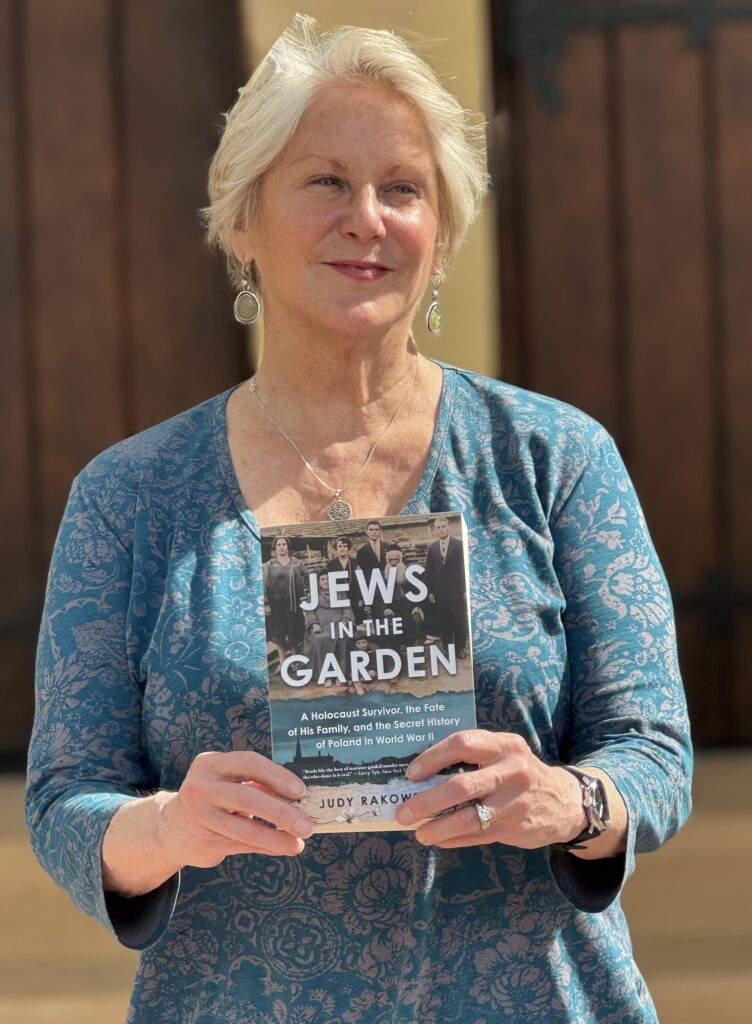
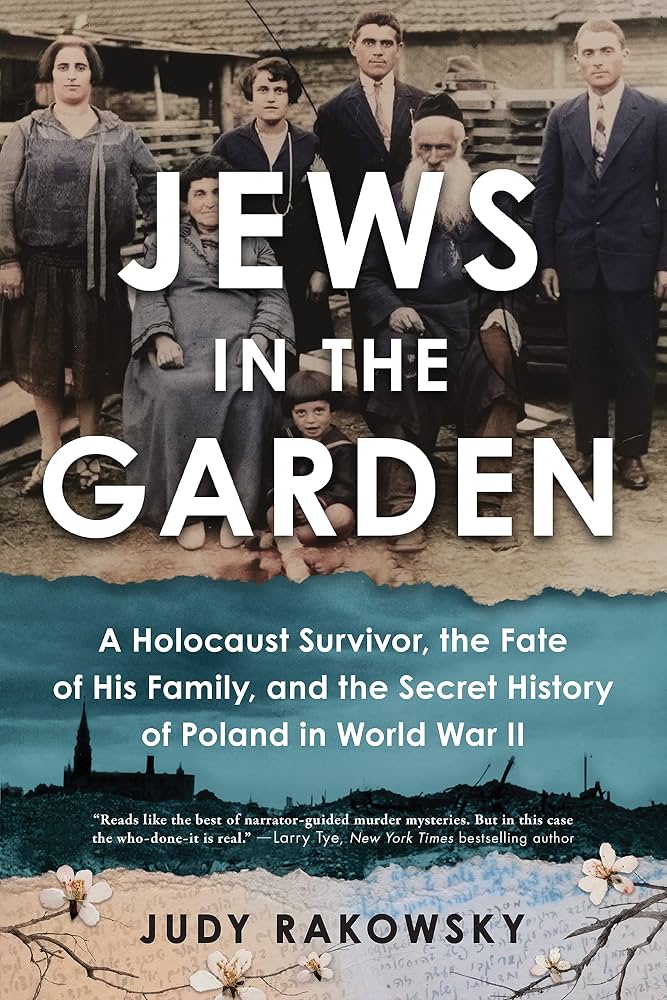
Congratulations, Judy, on publication of a monumental historical book. Can you please start with a birds-eye overview of Jews in the Garden, which is told in first person?
Jews in the Garden is part-memoir and part detective story about the journey over serial visits to Poland by a crime reporter, me, and my Cousin Sam, who survived the Holocaust in Nazi camps. In searching for the fate of our relatives we wound up discovering a hidden history that many to this day seek to keep secret.
The story dates back to my interviews of Sam – his first – about his Holocaust experiences for a Providence Journal Sunday Magazine story. I was captivated not only by what he went through but his enduring optimism and resilience. And he was my cousin.
After that story appeared, Sam started going back to Poland. I joined him again and again over three decades, each time learning new facts about the fate of relatives. Along the way we became close to descendants of Poles who had hidden our relatives at great personal risk.
As a journalist I had almost always written in third person, but pivoted to using the “I” word to reveal more layers of the story. Sam’s life experiences are almost impossible for most of us to imagine, so I decided that my reactions and observations to our experiences in Poland revealed and highlighted Sam’s, especially when he was welcomed back by neighbors and schoolmates and then treated with suspicion.
Along with you, Sam is a central character in the book. Who is he?
Sam is the first cousin of my father, who was born in the U.S. one year after Sam was born in Poland. Their fathers were brothers. My grandfather, Ben, the oldest of seven children, immigrated in 1913 from a town then part of Russia, avoiding lifelong conscription of Jewish males in the Czar’s Army. His brother, Joe, Sam’s father, served in the Polish Army in World War I, after border changes put the town near Krakow back into Poland. Joe ran the lumberyard my great grandfather started until the Nazi occupiers banned Jews from owning property. Through World War II, my family in Ohio did not know the fate of anyone left behind.
As you learn, Sam survived the Holocaust. Where was he living during it?
When the Nazis invaded Poland on Sept. 1, 1939, Sam was a teenager. In Sept. 1942, Sam’s family fled into hiding the weekend before the Nazi roundup of local Jews for deportation to the nearby death camp Belzec. They hid in a barn for two months. But marauding Nazis were shooting Jews they found in the countryside. Sam and family snuck into the Krakow ghetto and lived with dozens of relatives in a tiny apartment. By day, they went out to local factories doing slave labor. After five months, the Nazis liquidated the ghetto and Sam became a prisoner of Plaszow, the concentration camp depicted in Schindler’s List. One day he was ordered onto a cattle car headed for a camp in northeast Poland supplying slave labor for a munitions factory. In 1944, the munitions factory was disassembled to avoid capture by the advancing Red Army. Most of the prisoners were sent to Auschwitz, but Sam was one of the few Jews considered essential to reassembling the factory in Germany. He was sent to Sachsenhausen outside Berlin. With the Allies drawing near, the prisoners were forced on a death march toward the Baltic Sea where the Nazis planned to put the survivors on ships they would send out to sea and sink. Liberation came before that when Sam was near a coastal city in Germany. His first taste of liberation was cognac offered by American GIs.
How did you meet?
Sam was a quiet guy in the corner at big family gatherings growing up. I got to know him a bit when I worked near his home in Canton when I was an intern at the Plain Dealer in Cleveland. I visited his family for Passover a few years later right after he had just returned from his first trip back to his hometown. He jumped up after the meal to show us slides, saying “Let me show you where you come from.” He told spine-tingling stories and displayed amazing pride and warmth toward the place, our relatives and his hometown. I was riveted.
What inspired him — and you — to travel to Poland several times?
Sam healed from reconnecting with his early life and from chasing down the fate of relatives. There were hardly any records at the time, online or otherwise. I knew how to investigate crime stories, but this was a challenging assignment. Sam was a wily door knocker, asking folks of a certain age questions about what happened during the war in perfect Polish with engaging warmth. We got a tip about one cousin who survived, which spurred us on. We became a team on a quest, and we gathered good information that sent us in surprising directions. I picked up on his optimism and became a bit obsessed with the chase.
During your visits, you and Sam talked to many people. What did you ask? How were you received?
Many times we were received warmly but the tenor of the visits changed when Sam pressed his old mates from school and work on what became of Cousin Hena. They seemed to be hiding something. Also there was a lot of sensitivity around any acknowledgment of having helped Jews. One former neighbor said she gave bread to my great aunt who was hiding around town and knocked on her door late at night. But when this topic came up in the presence of other neighbors she said she sold the bread to her.
Was it only Nazis who murdered Jews in occupied Poland?
That was the guarded history. We discovered that near the end of the war bands of Polish partisans were attacking Jews in hiding, ensuring that they would not be able to reclaim their homes and businesses after the war. It was not something anyone in Poland wanted to discuss after the country went through so much after so many decades of occupation and domination by Nazis and then the Soviet communist regime. We heard this again and again about whole families of our relatives. Then I obtained a massive case file from the prosecution of dozens of alleged partisans, who were convicted and then pardoned.
Who were the Dulas and what happened to them?
One day when we were taken to a house to see Sam’s family dinner table that had been bought at a Nazi auction after the Jews were rounded up, Sam asked if the homeowner ever heard about his cousins the Dulas who might have hidden in that village. He said they were next door, buried in the root cellar. We went there and found a man who told us the whole story of his father hiding the Dula family of six adults for 18 months. Attackers came one night near the war’s end and demanded that his father produce the Jews he was hiding. He refused. But the attackers – Polish partisans – came back after getting a tip. They went to the hiding place under the barn and walked each of the Dulas up on a hill and shot them, forcing the man who hid them to bury them. This was all documented in great detail in the court records I obtained.
What is the garden in the title?
The granddaughter of the kind man who hid the Dulas said that school children had teased her about the “Jews in the Garden.” But until she witnessed her uncle telling us the story she never knew it was true.
A driving theme in Jews in the Garden is your search for what happened to a young girl named Hana. Please tell us about her.
Hana Rozenek was from another family of cousins Sam saw every day when he would stop by their shop on his way home from school. They found a hiding place before the roundup in another nearby hamlet. We pieced together the story of their grisly fate at the hands of Polish partisan attackers, but learned that one daughter – Hana – managed to flee. She was later brought to police and asked to identify two assailants but she claimed she did not see well enough in the dark to be sure.
How did you find her grade cards?
The current mayor of the town has been a wonderful ally in our pursuits, especially when the right wing government made it illegal in 2018 to write or say that Poles did anything to help the Nazis during the Holocaust. On our visits he produced the school records from before the Jews were rounded up and we found grades of Hena. On an early trip, Sam found his own school grades and it was very moving for him to see his name and his high marks as a student.
When and why did she stop her studies?
She was forced to stop her studies by the Nazi occupation.
Did you ever learn her fate?
Now why would I give away the ending?
You discovered that relatives of Sam and you were kept alive for a year and a half by a Christian family. Tell us about them — and what happened eventually to them.
We tracked several families including Sam’s own family and the cousins who lived in his same house growing up to their hiding places along with some of Hana’s hiding places. Sam, his parents, one aunt (also a Rakowski) who lived in the same house and one cousin are the only ones who survived out of scores of relatives who lived in the town. But many generous Christian Poles took in our relatives and several of them kept them fed and alive for 18 months. We are deeply grateful to them. Nazis threatened to kill entire villages if anyone was caught hiding Jews.
Does Jews in the Garden share the spirit of Stephen Spielberg’s Schindlers List?
I once interviewed the man who persuaded Thomas Kenneally to write the book that was pretty accurately captured in the movie. The book is an incredible achievement and great read about how Oskar Schindler, an Austrian industrialist, saved over 1,000 Jews, including some of my relatives. They chronicle the swagger and the derring do of Schindler as well as his flaws and the miracle of what he did. It was the first box office success for a Holocaust film. I hope JIG captures some of that spirit, of what Poles who tried to save Jews were up against.
Among many other favorable reviews, The New York Times published a laudatory review of you book, writing that “Rakowsky has written a moving and sometimes shocking book that often reads like a thriller… many passages, such as the one in which Sam and Judy discover the place where their murdered relatives are buried, are deeply affecting.” That must have delighted you, right?
I was really pleased that The New York Times chose a leading European historian to review my book. I was really gratified that he liked it. He pointed out that the secret history I chronicled was known to scholars – many of whom I quoted and whose work I relied upon – but not the general public. I find that difficult history needs to be brought to life through real people we relate to, and that’s why I resisted Sam saying it should have been a novel. I want people to know these are real people and we verified what happened to them.
OK, let’s hear some of your background. We were staff writers at The Providence Journal from 1985 to 1992. What did you cover?
I was in the Newport bureau my first year and besides chronicling tales of the super rich and the Tall Ships visit I wound up covering major trials, including courts martials on the Navy base that made national news. After a stint in the West Warwick bureau I landed the federal court beat and covered lots of organized crime news, including the major trial in Hartford in which underboss Nicholas Bianco was convicted and the first recording of a Mafia induction ceremony was played. I also covered the tragic murders of the Brendels by their investment advisor in Barrington that gripped the state and the nation.
Where did you go after you left the Projo?
In 1992 I joined the staff of The Boston Globe, where I worked as a reporter covering breaking news, federal courts, city hall, and investigative stories until 2000, when I joined the city desk. As an editor, I worked as the day city editor, night city editor, and other slots until I left in 2006. I taught journalism at Boston University for seven years, was a correspondent for People Magazine and did other freelancing while working on Jews in the Garden. In 2012, I joined the Boston strategic communications firm Liberty Square Group, where I still work as a consultant.
What’s next for Judy Rakowsky?
I’ve started down several roads on a new book, but have not yet settled on a topic. I am fascinated by the hijacking of history, which the Polish government did to its own national narrative about conduct of its citizens in the Holocaust. That preceded what we have witnessed in this country with intentional politicizing and distorting our own history. I am eager to find a compelling and revealing example on our landscape.